
1215 (year): Magna Carta, the Fourth Lateran Council and global events
Year 1215 was pivotal in medieval history: Magna Carta in England, the Fourth Lateran Council, and Genghis Khan's sack of Zhongdu among other political, religious, and cultural developments.
1215 is remembered as a consequential year across several regions of the medieval world. In Western Europe it saw dramatic contests over royal power and church authority; in East Asia the Mongol expansion reached a crucial stage; and in religious life the papacy convened one of its most important councils. The events of 1215 had long-term legal, ecclesiastical, and geopolitical effects that resonated well beyond the century.
Image gallery
2 Images
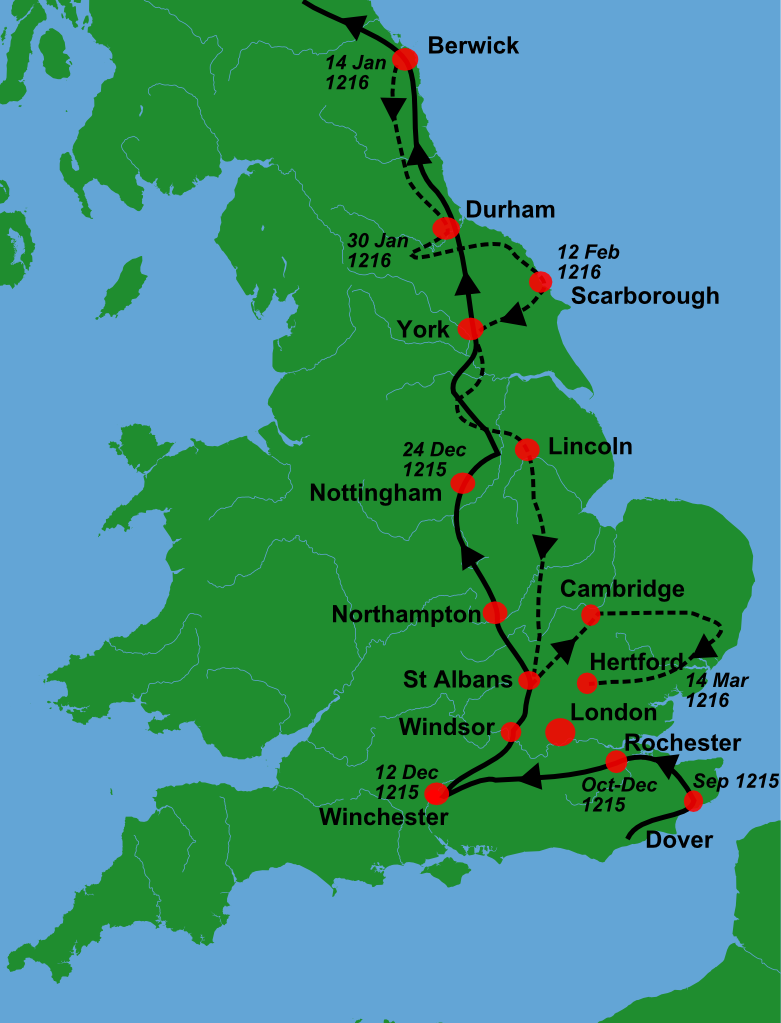
Major events
- Magna Carta (15 June 1215) — In England a group of barons forced King John to agree to a charter at Runnymede. The document limited certain royal powers, established procedures for justice, and asserted customary rights. Though immediately contested and reissued in modified forms, it became an enduring symbol and reference point for legal limits on arbitrary authority.
- Fourth Lateran Council (November 1215) — Convened by Pope Innocent III, this ecumenical council issued important canons on church reform, sacramental practice (including a clear articulation of the doctrine of the Eucharist), measures against heresy, and directives affecting clergy and laity alike. It also touched on social and interfaith regulations within Christendom.
- Mongol conquest of Zhongdu (1215) — In East Asia the forces of Genghis Khan captured and sacked Zhongdu (near present-day Beijing), a major capital of the Jin dynasty. The fall of the city marked a decisive phase in Mongol campaigns against northern Chinese regimes and accelerated political realignments in the region.
Regional developments and context
In England the agreement at Runnymede reflected rising noble resistance to royal fiscal demands and military failures abroad. Continental Europe experienced continued dynastic competition and papal influence; the Fourth Lateran Council also mobilised ecclesiastical structures and clarified pastoral obligations, which influenced religious life across Europe. In the wider Mediterranean and Near East, the papal council renewed calls for Christian unity and for actions that would affect later crusading efforts.
Importance and legacy
Though the immediate political effects of documents and decrees in 1215 varied—Magna Carta was annulled by the pope within weeks and led to civil conflict in England—the year's outcomes acquired lasting significance. Magna Carta has been cited over subsequent centuries as a foundational text for the rule of law, constitutionalism, and individual rights in Anglo‑American legal traditions. The Fourth Lateran Council shaped medieval ecclesiastical law, sacramental practice, and clerical discipline for generations. Mongol victories that year helped open pathways for further conquests and deep transformations in Eurasian political geography.
Other notes and distinctions
The numeral 1215 also appears in nonchronological contexts. As an integer it factors as 35×5, and has a modest set of divisors. When historians refer to "1215" without qualification they most often mean the year AD 1215 and its linked legal and religious landmarks. Because the year saw major developments in geographically distant areas, it is frequently studied as a crossroads of legal, religious and imperial change in the early thirteenth century.
Overall, 1215 stands out as a year in which local disputes, ecclesiastical reform, and imperial expansion produced documents and military outcomes whose repercussions lasted far beyond the immediate decade.
Related articles
Author
AlegsaOnline.com 1215 (year): Magna Carta, the Fourth Lateran Council and global events Leandro Alegsa
URL: https://en.alegsaonline.com/art/111138