
You Can't Run Away from It (1956 film)
1956 American musical comedy directed by Dick Powell. A musical remake of It Happened One Night, starring June Allyson and Jack Lemmon, with supporting comic turns and musical numbers. Distributed by Columbia Pictures.
Overview
You Can't Run Away from It is a 1956 American musical comedy directed by Dick Powell. The picture reworks the premise of Frank Capra's 1934 romantic comedy It Happened One Night as a mid‑century musical, blending screwball romance with song-and-dance interludes. It was released by Columbia Pictures.
Image gallery
1 Image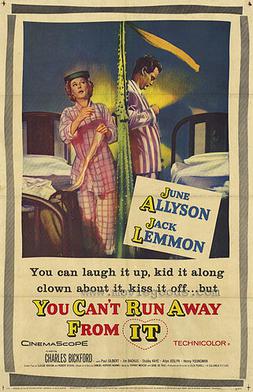
Plot and themes
The story follows a headstrong young woman who flees her wealthy surroundings and a determined reporter who crosses her path. Their mismatched journey—filled with misunderstandings, comic encounters and gradually deepening affection—mirrors the familiar road-trip romance of the earlier film but adds musical numbers that emphasize emotion and comic timing. Themes include independence, class differences, and the comic tension of two people who resist attraction until circumstances force them to confront it.
Cast and musical elements
The leads are June Allyson and Jack Lemmon, both known for their screen charm and comic abilities. Supporting performers include character actors of the era and entertainers such as comedian Henny Youngman and vocal group The Four Aces, who contribute musical performances. The film intersperses traditional song-and-dance numbers with light comedy, allowing the actors to showcase both acting and musical talents.
Production and historical context
Produced during the 1950s, when Hollywood often remade earlier hits in different genres, the film is an example of studios adapting successful stories to suit contemporary tastes and the popularity of musicals. Director Dick Powell, himself a former musical performer turned actor and director, guided the project toward a blend of romantic comedy and musical entertainment that reflected studio-era sensibilities.
Reception and legacy
At release the picture drew attention largely for its stars and its status as a remake rather than as a reinvention of the source material. While not as influential as the 1934 original, it remains of interest to fans of 1950s Hollywood musicals and of the principal performers. It illustrates studio practices of recycling classic plots while updating tone and presentation for a new audience.
Notable facts
- Remakes of well-known comedies into musicals were common in the 1950s as studios sought fresh draws.
- The film pairs a classic romantic premise with period musical styling, making it a useful study in genre adaptation.
- Key participants include prominent performers of the era and a major studio distributor, Columbia Pictures.
Questions and answers
Q: What is "You Can't Run Away from It"?
A: "You Can't Run Away from It" is a musical comedy movie released in 1956, directed by Dick Powell and featuring a star-studded cast including June Allyson, Jack Lemmon, and Charles Bickford.
Q: Who directed "You Can't Run Away from It"?
A: The movie was directed by Dick Powell.
Q: Who starred in "You Can't Run Away from It"?
A: The movie featured a star-studded cast including June Allyson, Jack Lemmon, Charles Bickford, Jim Backus, Allyn Joslyn, Henry Youngman, and The Four Aces.
Q: When was "You Can't Run Away from It" released?
A: "You Can't Run Away from It" was released in 1956.
Q: What type of movie is "You Can't Run Away from It"?
A: "You Can't Run Away from It" is a musical comedy.
Q: Who distributed "You Can't Run Away from It"?
A: The movie was distributed by Columbia Pictures.
Q: Is "You Can't Run Away from It" a popular movie?
A: There is no information provided to indicate whether or not "You Can't Run Away from It" is a popular movie.
Related articles
Author
AlegsaOnline.com You Can't Run Away from It (1956 film) Leandro Alegsa
URL: https://en.alegsaonline.com/art/110046