
Walther Rathenau
German industrialist, writer and politician (1867–1922). A leading liberal figure of the early Weimar Republic, he served briefly as Foreign Minister, promoted economic reconciliation and was assassinated by ultranationalists.
Walther Rathenau was born on 29 September 1867 in Berlin. A member of a prominent Jewish industrial family, he combined a business career in the electrical and industrial sectors with a public role as an essayist and cultural commentator. During and after the First World War he emerged as a leading advocate of democratic, social-liberal solutions to Germany’s political and economic problems.
Image gallery
7 Images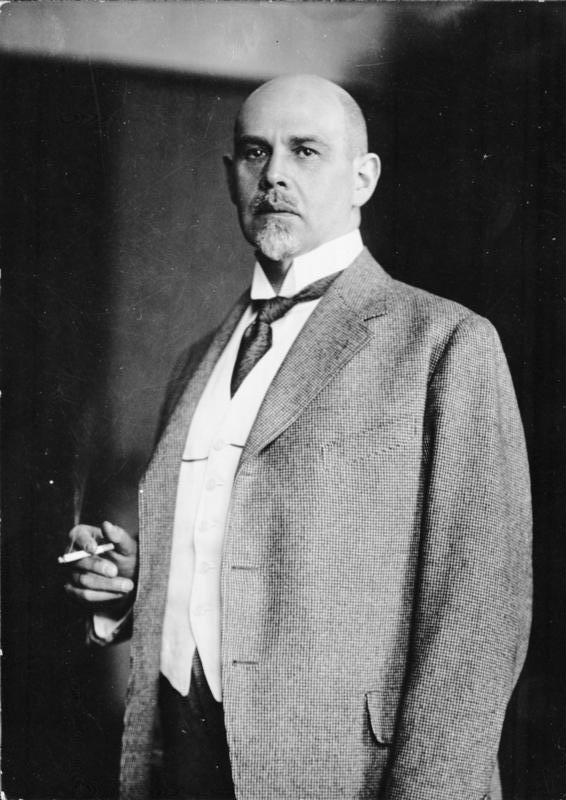


Early life and business career
Raised in an environment close to the new electrical industry, Rathenau acquired practical and managerial experience in major industrial enterprises. His successive roles in industry gave him an informed perspective on technology, production and the organisation of modern economic life, which he brought into his writing and later into public office.
Writings and public ideas
Rathenau published essays and lectures addressing economics, technology, culture and civic responsibility. He argued that modern industrial society required new forms of social cooperation and democratic governance, and he often sought to mediate between business interests, workers and the state. His style combined intellectual reflection with practical proposals, making him a well-known public intellectual of his time.
Political activity and ministership
Politically he belonged to the social-liberal tradition and joined the German Democratic Party (Deutsche Demokratische Partei). On 1 February 1922 he was appointed Reich Minister of Foreign Affairs. In that office he worked to end Germany’s diplomatic isolation after the war, sought economic agreements and aimed at the normalization of relations with other states. His pragmatic approach to foreign policy earned both supporters and determined enemies among nationalist circles.
Assassination and legal consequences
Rathenau was murdered on 24 June 1922 in Berlin by members of an ultranationalist and antisemitic group; the killing is commonly associated with the Organisation Consul (assassination details). The assassination shocked public opinion, prompted nationwide mourning and led the government to adopt stronger measures against political violence, including legislation intended to protect the republic and its institutions.
Legacy
Rathenau is remembered as a figure who bridged industry, intellectual life and statecraft during a turbulent period. His efforts to reconcile economic modernization with democratic values, and his public opposition to nationalist extremism, made him a symbol of the liberal, cosmopolitan strand of Weimar politics. His assassination is widely seen as an early and ominous sign of the violent challenges the republic would face.
Quick facts
- Born: 29 September 1867, Berlin
- Died: 24 June 1922, Berlin
- Background: Jewish descent; industrial and intellectual leader
- Party: German Democratic Party
- Position: Foreign Minister (February–June 1922)
- Assassinated by: ultranationalist militants; associated with Organisation Consul
Related articles
Author
AlegsaOnline.com Walther Rathenau Leandro Alegsa
URL: https://en.alegsaonline.com/art/106411