
Bennett's tree-kangaroo (Dendrolagus bennettianus)
A large arboreal marsupial from northeastern Australia, Bennett's tree-kangaroo is adapted to life in rainforest canopies with strong forelimbs, a long tail, and remarkable leaping and dropping ability.
Overview
Bennett's tree-kangaroo (Dendrolagus bennettianus) is a large arboreal marsupial in the macropod family, native to the rainforests of northeastern Australia. As a member of the genus Dendrolagus, it is one of several tree-dwelling kangaroos that have evolved from terrestrial macropods to exploit forest canopies. The species is well known for its unusual combination of climbing skill and the capacity to survive substantial falls.
Image gallery
3 Images

Appearance and adaptations
Bennett's tree-kangaroo has a compact, muscular body with features adapted for arboreal living. Notable characteristics include robust forelimbs and shoulders for climbing, curved claws for gripping branches, and a long tail that aids balance when moving among trees. Males are typically larger than females; reported adult male weights range from about 11.5 kg up to almost 14 kg, while females commonly weigh around 8 to 10.6 kg. These animals have dense fur that varies in colour across individuals and provides insulation in cool, shaded forest environments.
Habitat, range and history
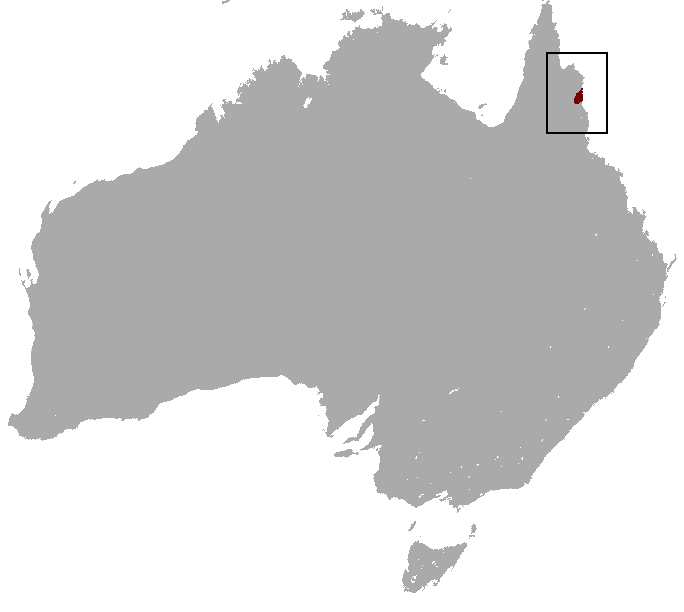
This species is associated with tropical and subtropical rainforest habitats in northeastern Australia, where it spends much of its time in the canopy. Fossil and historical records show that tree-kangaroos represent an evolutionary shift from ground-dwelling kangaroos toward a life spent largely above ground. Indigenous peoples of the region have long been familiar with tree-kangaroos and feature them in local ecological knowledge.
Behavior, diet and reproduction
Bennett's tree-kangaroos are primarily solitary and show a mix of nocturnal and crepuscular activity. Their diet consists mainly of leaves, fruit, flowers and other plant matter found in the trees. As marsupials, females rear their young in a pouch; the dependent young are commonly referred to as joeys. Reproduction and life-history traits are similar to other tree-kangaroos, with relatively slow reproductive rates compared with small rodents or birds.
Notable facts and conservation
One remarkable trait of Bennett's tree-kangaroo is its ability to move vertically and to tolerate considerable drops: individuals can leap several metres between branches and have been observed dropping down about 9 metres (roughly 30 ft) to a lower branch. There are also reports of tree-kangaroos falling to the ground from heights up to around 18 metres (59 ft) without apparent injury, an indication of their strong limbs and shock-absorbing physiology. Because they depend on rainforest canopy, habitat loss, fragmentation and other human pressures are concerns for their long-term well-being. The species is studied by conservationists and naturalists, and visitors can sometimes encounter information about it in regional wildlife guides. For further reading, see additional resources.
- Taxonomic group: Marsupial, family Macropodidae, genus Dendrolagus
- Distribution: Northeastern Australian rainforests
- Key adaptations: strong forelimbs, long tail, curved claws, dense fur
Tags
Related articles
Author
AlegsaOnline.com Bennett's tree-kangaroo (Dendrolagus bennettianus) Leandro Alegsa
URL: https://en.alegsaonline.com/art/10562
Sources
- bucknell.edu : Mammal Species of the World
- iucnredlist.org : "Dendrolagus bennettianus"
- doi.org : 10.2305/IUCN.UK.2008.RLTS.T6426A12759345.en
- animaldiversity.ummz.umich.edu : "Dendrolagus bennettianus"