
Urbain Le Verrier — French mathematician and astronomer (1811–1877)
Urbain Le Verrier (1811–1877) was a French mathematician and astronomer who predicted Neptune's position from perturbations in Uranus's motion, directed the Paris Observatory and made lasting contributions to celestial mechanics.
Urbain Jean Joseph Le Verrier (born March 11, 1811 — died September 23, 1877) was a French mathematician and astronomer whose theoretical calculations led to the observational discovery of the planet Neptune. Working within the framework of Newtonian celestial mechanics, he analysed anomalies in the orbit of Uranus and used perturbation theory to infer the existence and approximate position of an unseen planet.
Image gallery
5 Images



Prediction of Neptune
Le Verrier's work consisted of detailed analytic computation of gravitational perturbations. By comparing observed motion with predictions from known planets, he derived corrections that pointed to a body beyond Uranus. In 1846 his predictions were communicated to observers, and a new planet was identified very near the position he indicated. The episode demonstrated the explanatory and predictive power of mathematical astronomy and remains a classical example of theory guiding observation.
Priority and international context
The Neptune episode involved parallel work by other astronomers, notably a British calculation that reached similar conclusions. The near-simultaneous efforts gave rise to debate over priority and interpretation — an historical case of independent discovery that also illustrates the competitive, international character of nineteenth-century science. The observational confirmation of the predicted planet strengthened confidence in Newtonian gravitation.
Career and other contributions
Le Verrier held important scientific and administrative posts in France, later becoming director of the Paris Observatory. He produced influential studies of planetary perturbations, the motion of comets and the long-term stability of the solar system. He also worked on practical ephemerides used by navigators and astronomers, and examined atmospheric and meteor phenomena in connection with observational records.
Legacy
Le Verrier's achievement is widely cited in accounts of celestial mechanics and the history of astronomy. His calculations exemplify the application of advanced mathematical methods to observational problems, and his name is commemorated in astronomical literature and by honors that recall his role in predicting a new planet.
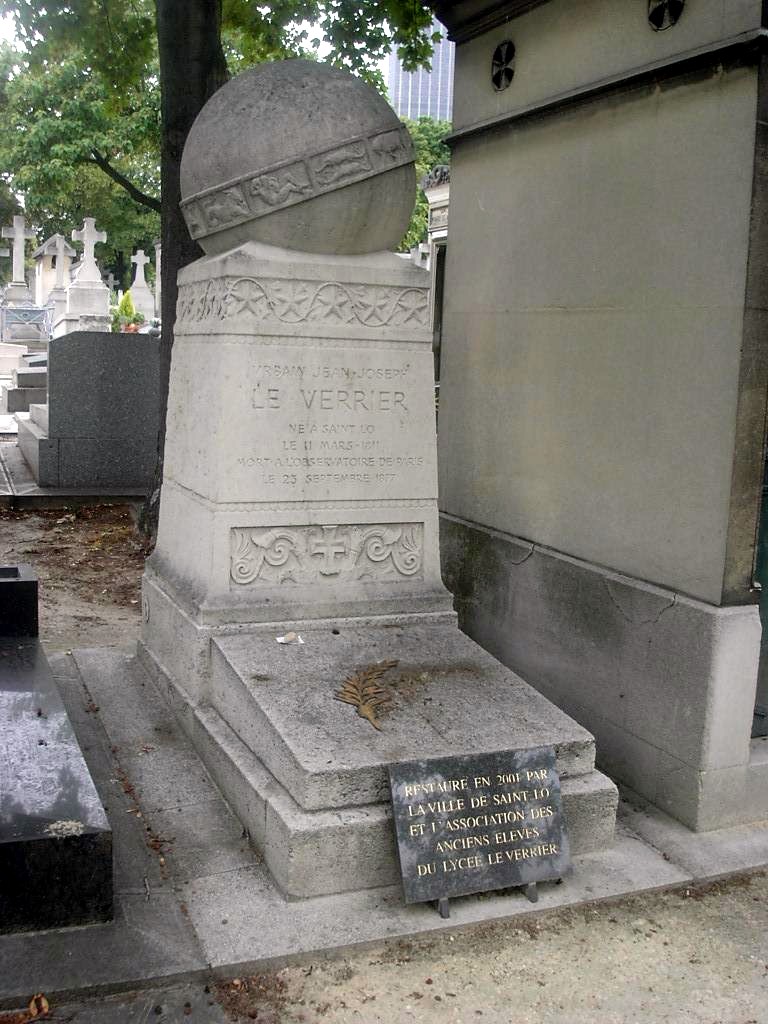
- Born: March 11, 1811
- Died: September 23, 1877
- Nationality: French
- Profession: mathematician and astronomer
- Known for: theoretical prediction of Neptune and work in celestial mechanics
Related articles
Author
AlegsaOnline.com Urbain Le Verrier — French mathematician and astronomer (1811–1877) Leandro Alegsa
URL: https://en.alegsaonline.com/art/103552