
Upstairs and Downstairs (1959 British comedy-drama film)
A 1959 British comedy-drama directed by Ralph Thomas, adapted from a novel by Ronald Scott Thorn and featuring an ensemble cast including Michael Craig, Claudia Cardinale, and Oliver Reed.
Overview
Upstairs and Downstairs is a 1959 British comedy-drama film directed by Ralph Thomas. Released during the postwar era of British cinema that often mixed social observation with light entertainment, the picture was adapted from a novel by Ronald Scott Thorn and distributed by 20th Century Fox. Its title evokes a familiar contrast between the lives of household residents and the domestic staff, and the film uses that contrast as a springboard for humor and interpersonal conflict.
Image gallery
1 Image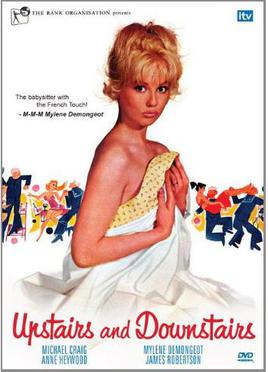
Cast and principal contributors
The film assembles a varied ensemble of established and emerging performers. Leading names associated with the production include:
- Michael Craig
- Anne Heywood
- James Robertson Justice
- Sid James
- Claudia Cardinale
- Daniel Massey
- Reginald Beckwith
- Susan Hampshire
- Oliver Reed
Many of these actors were notable figures in British and international screen acting: some were veteran character performers, while others were at earlier stages of careers that would later bring wider recognition.
Source material and production
The film is an adaptation of a novel by Ronald Scott Thorn. Ralph Thomas, the director, was active in mid-20th-century British filmmaking and often worked on productions that balanced commercial appeal with elements of social comedy. 20th Century Fox handled distribution, enabling the film to reach both domestic and overseas markets typical for British features of the time.
Themes, tone and style
As a comedy-drama, Upstairs and Downstairs blends humorous situations with character-driven moments. The narrative framework suggested by the title lends itself to exploring class differences, workplace hierarchies within a household, and the everyday foibles of a mixed ensemble. Stylistically the film sits with contemporary British pictures that favored dialogue, situational irony, and performances over spectacle.
Reception and legacy
While not as widely cited today as major classics of its era, Upstairs and Downstairs is of interest to students of British cinema for its cast and for illustrating trends in 1950s film production and adaptations. It is distinct from the later and unrelated BBC television series Upstairs, Downstairs (1970s), which dealt with similar upstairs/downstairs themes but is a separate property and cultural phenomenon. For further information on cast biographies and related works, consult dedicated filmographies and archival sources.
References to contemporary reviews and archival releases provide deeper context for the film's place in postwar British screen history; specialized film databases and library catalogues can supply original credits, release dates, and distribution notes.
Questions and answers
Q: When was Upstairs and Downstairs released?
A: Upstairs and Downstairs was released in 1959.
Q: Who directed the movie Upstairs and Downstairs?
A: The movie Upstairs and Downstairs was directed by Ralph Thomas.
Q: What is the genre of Upstairs and Downstairs?
A: Upstairs and Downstairs is a British comedy drama movie.
Q: Who wrote the book on which the movie is based?
A: The book on which the movie is based was written by Ronald Scott Thorn.
Q: Who are some of the actors featured in Upstairs and Downstairs?
A: Actors included Michael Craig, Anne Heywood, James Robertson Justice, Sid James, Claudia Cardinale, Daniel Massey, Reginald Beckwith, Susan Hampshire, and Oliver Reed.
Q: Who distributed Upstairs and Downstairs?
A: Upstairs and Downstairs was distributed by 20th Century Fox.
Q: Is Upstairs and Downstairs a well-known movie?
A: Upstairs and Downstairs may not be as well-known as some other movies, but it has its own place in the British cinema history.
Related articles
Author
AlegsaOnline.com Upstairs and Downstairs (1959 British comedy-drama film) Leandro Alegsa
URL: https://en.alegsaonline.com/art/103518