
United States ten-dollar bill
Overview, design, history, security features, and uses of the United States ten-dollar Federal Reserve note featuring Alexander Hamilton.
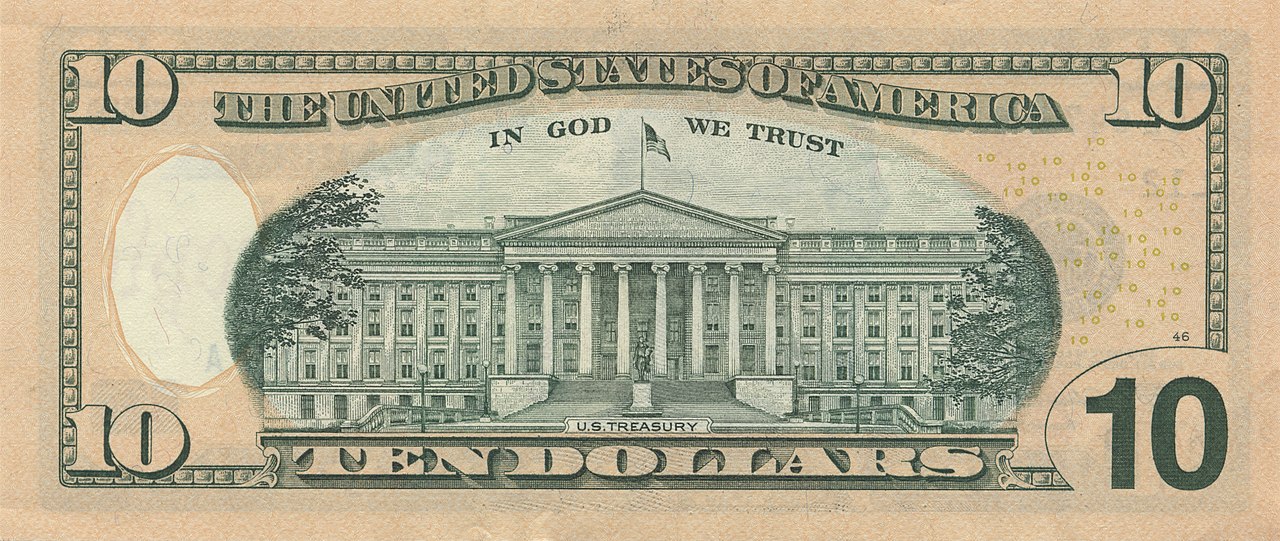
The United States ten-dollar bill is a Federal Reserve note and a common denomination of U.S. paper currency. Its obverse traditionally displays a portrait of Alexander Hamilton, the nation's first Secretary of the Treasury, and the reverse shows imagery associated with the Treasury. It functions as legal tender for all debts, public and private, and circulates alongside other denominations in everyday commerce.
Image gallery
10 Images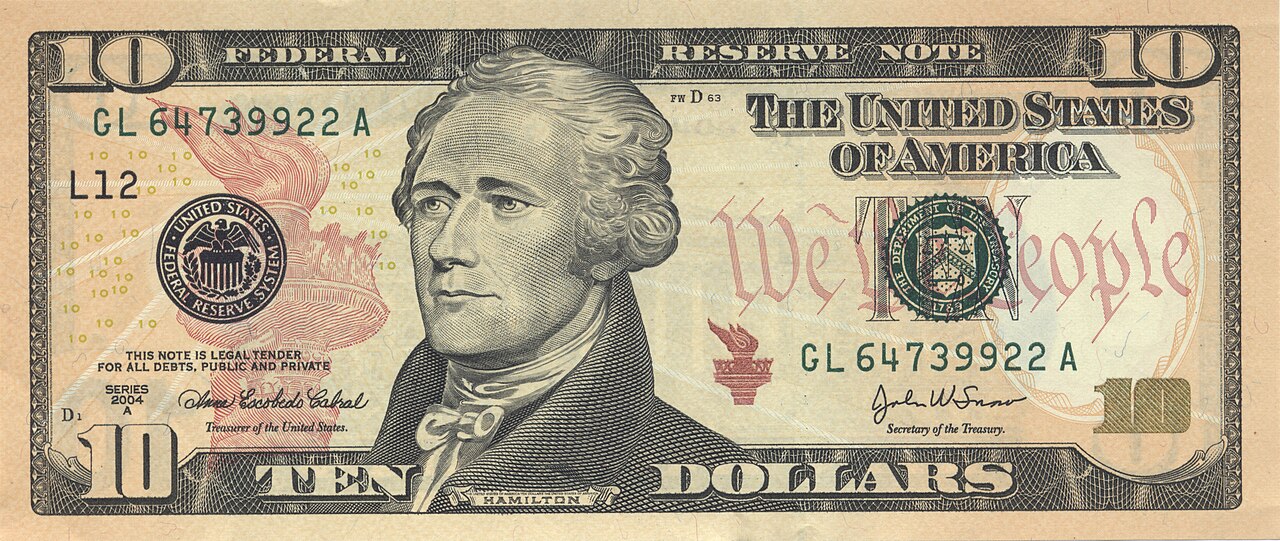



Design and appearance
Modern ten-dollar notes share the standardized size and general layout of U.S. banknotes but incorporate distinctive colors and graphics to aid recognition. Recent series introduced subtle background hues and enlarged portrait elements to improve aesthetic clarity and deter counterfeiting. Typical elements include a detailed central portrait, denomination numerals in the corners, inscriptions denoting Federal Reserve issuance, and ornamental vignettes.
Security features
To reduce counterfeiting the bill includes multiple security devices that are common across contemporary U.S. currency. These may include a watermark matching the portrait, a security thread embedded in the paper, microprinting in fine text, color-shifting ink on numerals, and raised intaglio printing that can be felt by touch. The combination of features is intended to be readily checked by both machines and the public.
History and development
The ten-dollar denomination has existed in various forms since the early years of the United States. Its visual design has evolved through many series, shifting from large-format notes to the smaller standardized format used since the 20th century. The choice of Alexander Hamilton honors his role in establishing the nation's financial system and is a longstanding element of the note's identity.
Use and cultural notes
- The $10 bill is widely used for everyday transactions, ATM withdrawals, and as change in retail settings.
- As with other banknotes, its design elements are periodically reviewed and updated to balance usability, security, and historical representation.
- For more information on U.S. currency, see United States currency.
The ten-dollar bill remains an integral part of American cash circulation and a familiar symbol of federal monetary authority.
Related articles
Author
AlegsaOnline.com United States ten-dollar bill Leandro Alegsa
URL: https://en.alegsaonline.com/art/103141
Sources
- uscurrency.gov : "Weight of a US Banknote"