
Uecker-Randow — former district of Mecklenburg-Western Pomerania
Former district in eastern Mecklenburg-Western Pomerania, Germany, established 1994 from Pasewalk, Ueckermünde and part of Strasburg; merged into Vorpommern-Greifswald in 2011. Geography, history and legacy.
Overview
Uecker-Randow was an administrative district in the eastern part of Mecklenburg-Western Pomerania, Germany. Formed in the 1990s administrative reforms, it combined coastal and inland landscapes and included several small towns and rural communities. The district no longer exists as an independent unit after a state-wide reorganisation in 2011, when it became part of Vorpommern-Greifswald.
Image gallery
1 Image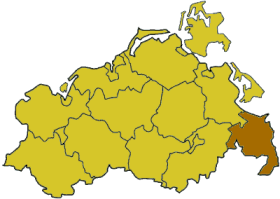
Geography and landscape
The territory covered both lowland river valleys and areas influenced by the Baltic Sea and adjacent lagoons. Notable geographic features included river systems and coastal wetlands, together with mixed forests, agricultural plains and lakes. These varied landscapes supported local agriculture, small ports and nature reserves that attracted regional visitors and conservation attention.
History and administrative development
The district was created on 12 June 1994 by merging the former districts of Pasewalk and Ueckermünde and incorporating part of Strasburg. This consolidation reflected efforts to streamline local government after German reunification. On 4 September 2011 a later administrative reform dissolved Uecker-Randow and merged its area into the larger district of Vorpommern-Greifswald, changing local administrative structures and service delivery.
Economy, population and communities
The economy combined agriculture, forestry, fisheries and small-scale manufacturing, with tourism around the coast and protected landscapes. Like many rural parts of eastern Germany, the area experienced demographic shifts including out-migration and an ageing population, which influenced local planning and public services.
Towns and notable places
- Pasewalk — an inland market town with regional transport links
- Ueckermünde — a coastal town near the lagoon with harbour and seaside features
- Strasburg (part) — a small town included in the 1994 formation
Legacy and significance
Although Uecker-Randow no longer exists as an administrative unit, its territory remains relevant for regional planning, cultural identity and cross-border relations with Poland. The area's combination of coastal and inland features continues to shape economic opportunities and conservation priorities in the successor district of Vorpommern-Greifswald.
Questions and answers
Q: Where is Uecker-Randow located?
A: Uecker-Randow is a former district located in the eastern part of Mecklenburg-Western Pomerania, Germany.
Q: When was Uecker-Randow created?
A: Uecker-Randow was created on 12 June 1994.
Q: What old districts were joined to create Uecker-Randow?
A: The old districts of Pasewalk, Ueckermünde, and part of the district Strasburg were joined to create Uecker-Randow.
Q: What happened to Uecker-Randow on 4 September 2011?
A: Uecker-Randow was merged into Vorpommern-Greifswald on 4 September 2011.
Q: What type of district was Uecker-Randow?
A: Uecker-Randow was a former district in Germany.
Q: What is Mecklenburg-Western Pomerania?
A: Mecklenburg-Western Pomerania is a state in northern Germany.
Q: Is Uecker-Randow still a district?
A: No, Uecker-Randow is a former district that was merged into Vorpommern-Greifswald in 2011.
Related articles
Author
AlegsaOnline.com Uecker-Randow — former district of Mecklenburg-Western Pomerania Leandro Alegsa
URL: https://en.alegsaonline.com/art/102524