
Twenty-fourth Amendment to the United States Constitution
Prohibits requiring payment of a poll tax as a condition for voting in federal elections; proposed 1962, ratified 1964; includes enforcement power for Congress and influenced later Supreme Court rulings.
Overview
The Twenty-fourth Amendment to the United States Constitution forbids conditioning the right to vote in federal elections on payment of a poll tax or other tax. Adopted during the civil rights era, the amendment removed a barrier that had been used to restrict participation in national elections and provided Congress with authority to enforce the prohibition by legislation.
Image gallery
2 Images
Background and purpose
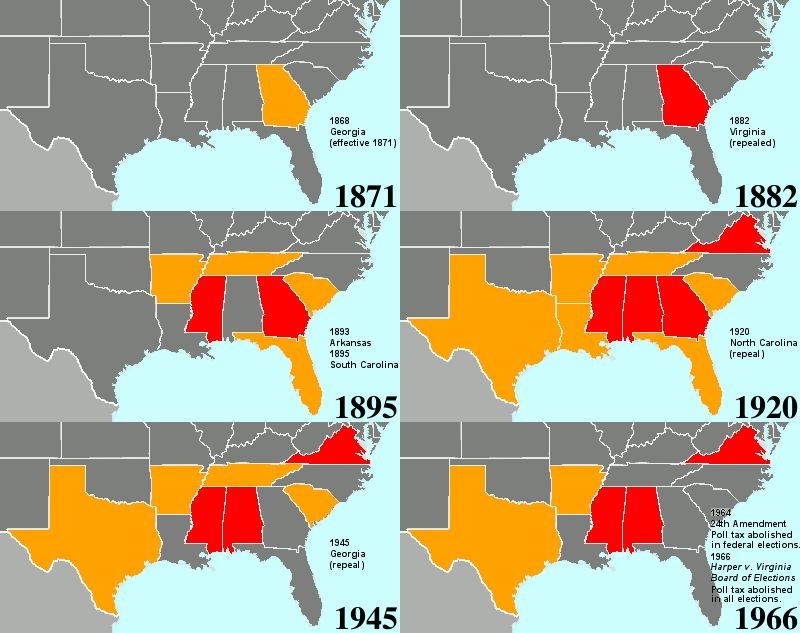
During the late 19th and early 20th centuries, several states — particularly in the South — adopted poll taxes and similar measures as one method to reduce turnout among poor voters and racial minorities. Opponents argued these requirements violated basic democratic principles because they linked the franchise to a voter's ability to pay. The Twenty-fourth Amendment was drafted to end that practice in federal contests and to strengthen equal access to the ballot.
Text, proposal, and ratification
Congress proposed the amendment to the states on August 27, 1962. The required number of state ratifications was achieved and the amendment became part of the Constitution on January 23, 1964. The amendment also contains an enforcement clause giving the United States Congress power to pass appropriate legislation to implement its provisions.
Effects and subsequent developments
Because the amendment explicitly addresses federal elections, some states continued to impose poll taxes in state or local contests after 1964. Within a few years the Supreme Court extended the principle more broadly: in a major decision the Court held that state-imposed poll taxes in elections for state office violated the Equal Protection Clause of the Fourteenth Amendment, effectively ending the practice for state elections as well.
Key points and legacy
- Prohibits requiring payment of a poll tax as a condition for voting in federal elections.
- Proposed by Congress in 1962 and ratified on January 23, 1964.
- Contains an enforcement clause empowering Congress to enact implementing laws.
- Played an important role in mid-20th century civil rights efforts to expand and protect the franchise.
The Twenty-fourth Amendment is often discussed alongside other mid-century reforms that removed formal obstacles to voting, including federal legislation and court rulings that targeted discriminatory practices. Its adoption marked a formal constitutional rejection of tax-based barriers to federal suffrage and contributed to broader changes that strengthened voter access across the United States.
Related articles
Author
AlegsaOnline.com Twenty-fourth Amendment to the United States Constitution Leandro Alegsa
URL: https://en.alegsaonline.com/art/102232
Sources
- archives.gov : "The Constitution of the United States: Amendments 11-27"