
Twenty-second Amendment to the United States Constitution
Constitutional amendment limiting how many times a person may be elected President of the United States; passed by Congress in 1947 and ratified in 1951, with a rule for partial terms.
Overview
The Twenty-second Amendment places a constitutional limit on the number of times a person may be elected to the office of President of the United States. It specifies that no one may be elected president more than twice and sets a special rule for individuals who have served part of another person's term. The amendment was sent to the states by Congress in 1947 and completed ratification in 1951.
Image gallery
4 Images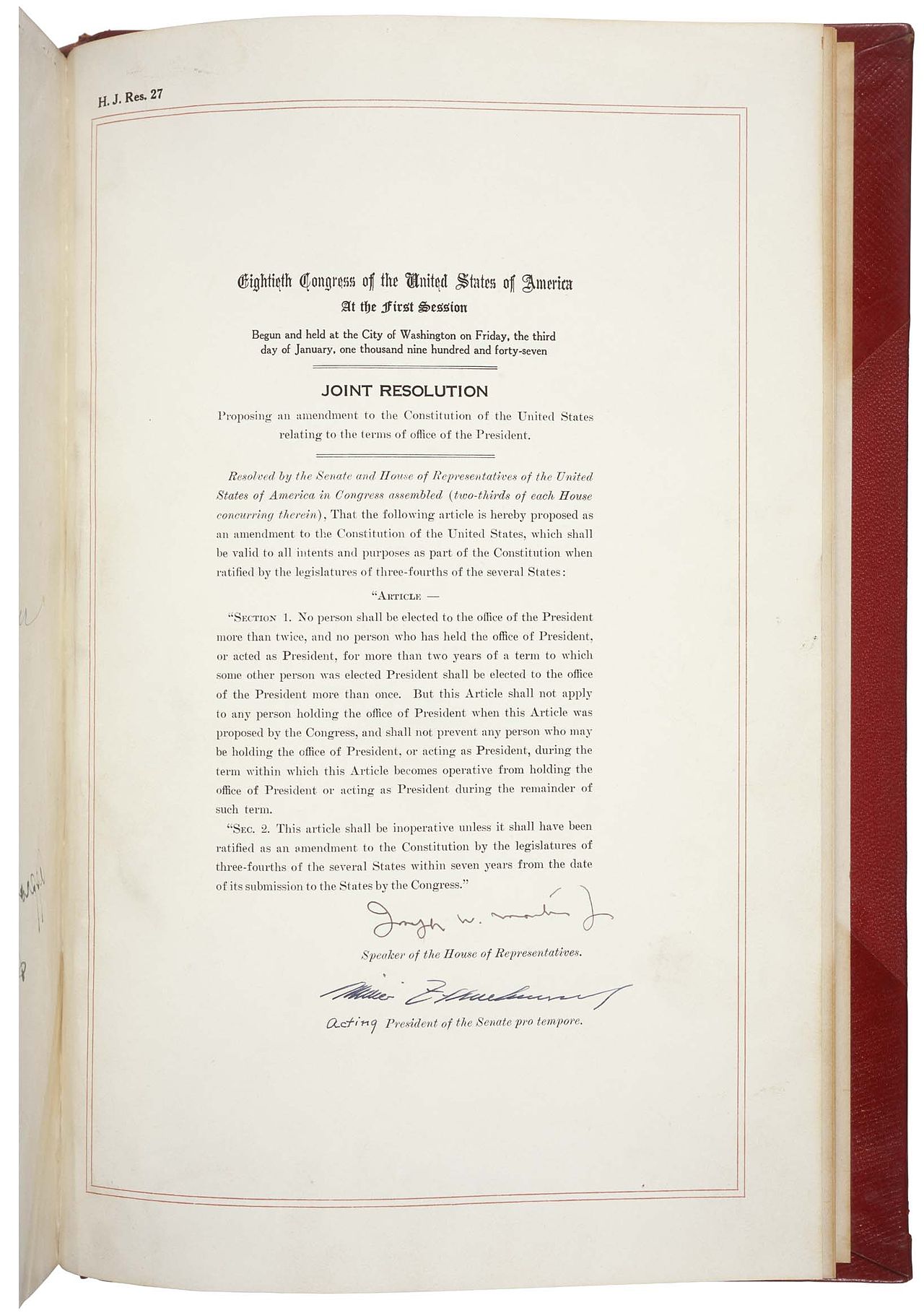



Key provisions and interpretation
The text contains two central constraints: a ban on being elected to the presidency more than twice, and a clause that limits election eligibility for anyone who has already served more than two years of a term to which another person was elected. Put simply, a person who becomes president by succession and serves two years or less of that term may still be elected twice; if they serve more than two years, they may only be elected once thereafter. This produces a commonly cited maximum of roughly ten years of service in the presidency under certain circumstances.
Historical background
The amendment emerged after President Franklin D. Roosevelt was elected to four terms, breaking a longstanding two-term custom rooted in the example of George Washington. In response to concerns about concentrated executive power and the erosion of tradition, Congress proposed the amendment and the states ratified it. The measure contains a transitional clause that exempted the sitting president at the time of proposal from its restrictions.
Practical effects and notable points
- The amendment limits future presidents by election count rather than strictly by years of service.
- It distinguishes between election to the office and service by succession.
- Legal and political debates sometimes address edge cases, but the amendment has been in effect since ratification.
For further reading on how the amendment was proposed and ratified, see contemporary congressional materials and state ratification records: proposal and congressional record, presidential succession details, and ratification documentation.
Questions and answers
Q: What is the Twenty-second Amendment to the United States Constitution?
A: The Twenty-second Amendment to the United States Constitution is an addition to the United States Constitution that puts a limit on how many times a person can be elected to be President.
Q: What is the limit set by the Twenty-second Amendment to the United States Constitution?
A: The limit set by the Twenty-second Amendment to the United States Constitution is that a person can be elected twice or once if they have already served more than two years as the President.
Q: When was the Twenty-second Amendment to the United States Constitution passed by Congress?
A: The Twenty-second Amendment to the United States Constitution was passed by Congress in March 1947.
Q: When was the Twenty-second Amendment to the United States Constitution ratified?
A: The Twenty-second Amendment to the United States Constitution was ratified on February 27, 1951.
Q: Why was the Twenty-second Amendment to the United States Constitution required?
A: The Twenty-second Amendment to the United States Constitution was required to ensure that no President overstays their welcome in the White House and it promotes democracy.
Q: Can a person serve more than two terms as President before the Twenty-second Amendment to the United States Constitution?
A: Yes, a person could serve more than two terms as a President before the Twenty-second Amendment to the United States Constitution.
Q: How does the Twenty-second Amendment to the United States Constitution prevent someone from serving more than two terms as President?
A: The Twenty-second Amendment to the United States Constitution prevents someone from serving more than two terms as President by putting a limit on how many times a person can be elected to be President.
Related articles
Author
AlegsaOnline.com Twenty-second Amendment to the United States Constitution Leandro Alegsa
URL: https://en.alegsaonline.com/art/102235