
Torn Curtain (1966 film)
A Cold War spy thriller directed by Alfred Hitchcock, starring Paul Newman and Julie Andrews. The film follows an American scientist who feigns defection to the Eastern Bloc to uncover weapons secrets.
The 1966 film Torn Curtain was directed by Alfred Hitchcock and starred Paul Newman and Julie Andrews. Set largely in East Germany at the height of the Cold War, it centers on an American researcher who pretends to turn his back on the West to obtain crucial intelligence. The story blends political suspense with Hitchcock's signature focus on moral ambiguity and tension.
Image gallery
1 Image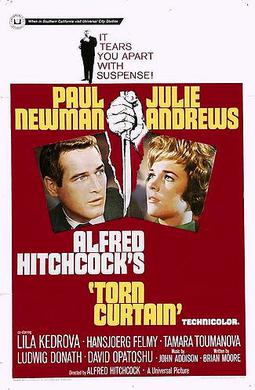
Overview and plot context
The protagonist is an American scientist who undertakes a risky ruse: he stages a defection to gain access to a secret weapons program in the Eastern Bloc. His apparent betrayal creates personal and ethical conflicts, especially in his relationship with his partner, and leads to a series of escapes and close calls that drive the narrative. The film emphasizes the human cost of espionage as much as the mechanics of spy craft.
Characteristics and notable scenes
- Atmosphere: a bleak, controlled portrayal of life behind the Iron Curtain contrasted with tightly choreographed suspense sequences.
- Performance: the casting of two major stars known for non-genre work gave the film a different tone from Hitchcock’s earlier thrillers.
- Memorable moments: a prolonged and stark struggle sequence in a rural setting is frequently cited by critics and scholars as unusually visceral for Hitchcock.
Production and themes
Torn Curtain was made during a period when Cold War tensions shaped popular culture. Hitchcock explored themes of deception, loyalty and moral compromise while also experimenting with star-driven casting. The film balances procedural elements—surveillance, clandestine meetings, and border crossings—with the director’s interest in ordinary people placed in extraordinary moral situations.
Reception and legacy
Upon release the film received a mixed response: some praised its craftsmanship and topical subject, while others found it less suspenseful than Hitchcock’s landmark works. Over time it has been reassessed by critics and historians who study how mainstream cinema depicted the Cold War. Today Torn Curtain is frequently discussed in surveys of Hitchcock’s late career and in studies of film portrayals of espionage.
Further points and distinctions
- Compared with Hitchcock’s earlier psychological thrillers, this picture places more emphasis on geopolitical stakes than on intimate obsession.
- Its combination of big-name stars and political plotting makes it an example of 1960s studio filmmaking attempting to merge prestige casting with topical subjects.
- Researchers and viewers interested in Cold War cinema, Hitchcock’s oeuvre, or star studies often return to the film for its unusual tone within the director’s filmography.
For more contextual information, production notes, and cast lists, follow the primary references associated with the film through the links above.
Related articles
Author
AlegsaOnline.com Torn Curtain (1966 film) Leandro Alegsa
URL: https://en.alegsaonline.com/art/100693
Sources
- imdb.com : Torn Curtain