
“Think of the children”: a rhetorical appeal and its uses
An encyclopedia overview of the phrase “Think of the children,” its rhetorical character, history in debates about censorship and welfare, examples of use, and how to evaluate claims invoking children.
Overview
"Think of the children" (often phrased as "What about the children?") is a rhetorical appeal that invokes the welfare of minors to influence opinion or policy. Used sincerely, it raises legitimate concerns about safety, exploitation, or rights. More commonly in public debate it functions as an emotional prompt designed to steer discussion toward protective action or away from contested proposals. Because children are widely regarded as vulnerable and deserving of special consideration, the phrase can quickly mobilize sympathy and reduce resistance to a proposed course of action.
Image gallery
2 Images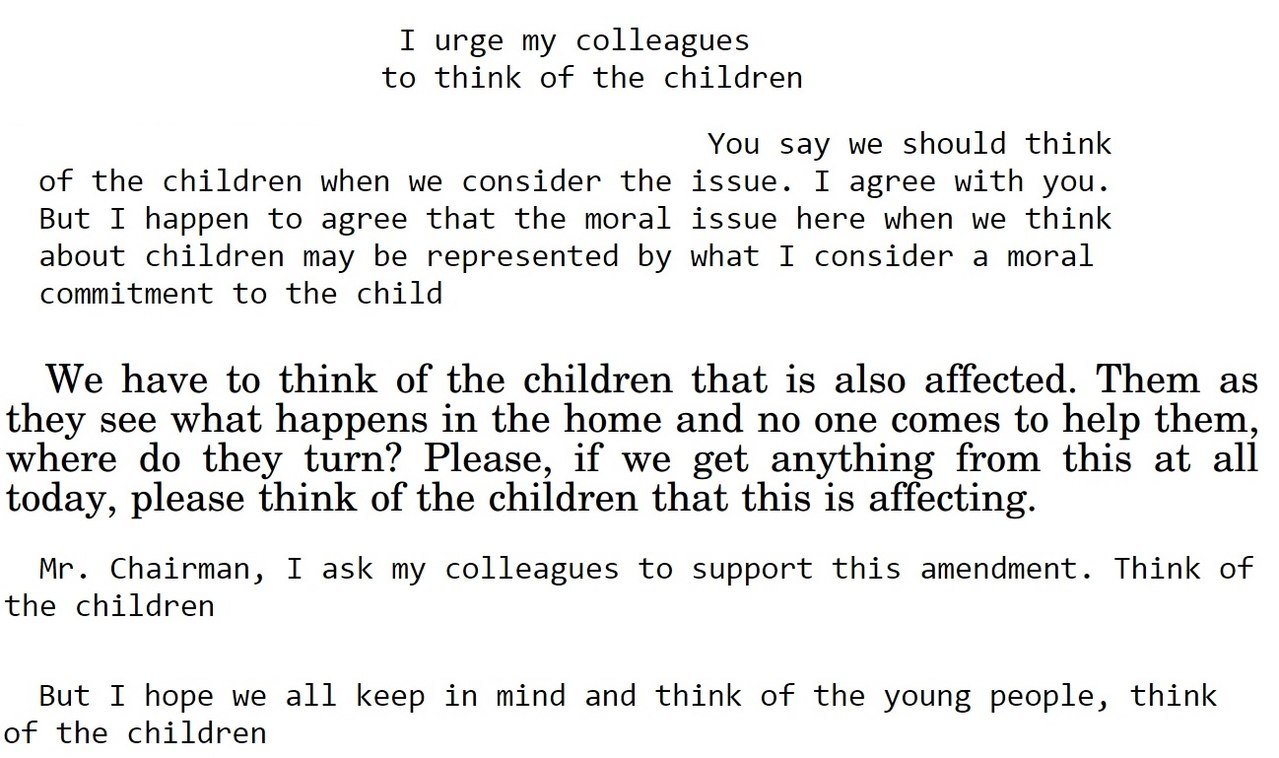
Characteristics and rhetorical function
As a device, the phrase typically shifts attention from abstract principles or empirical evidence to immediate moral imagery. Critics classify it as a form of appeal to emotion: rather than addressing arguments on their merits, a speaker foregrounds potential harm to children to create urgency or moral pressure. Observers contrast this tactic with deliberative reasoning and evidence-based policymaking, noting how an emotionally charged refrain can shorten debate and discourage dissenting voices. Some scholars treat it as one among several persuasive strategies that replace argument with sentiment; others point out that invoking children is sometimes a legitimate ethical shortcut when empirical study is impractical (see related discussion).
History and notable contexts
The phrase has appeared in many historical and cultural debates. It featured in campaigns for censorship and media regulation, in discussions about sex education, videogames and violent entertainment, and in legislative initiatives concerning child labor, internet safety, and schooling. Commentators and ethicists have explored why appeals that foreground childhood protection are politically potent and often decisive in moral controversies. Some critics argue the appeal can short-circuit reasoned deliberation (analysis of reasoned debate), while others emphasize its recurring role across eras and media in shaping public policy (further reading). Scholars have also linked the phrase to broader phenomena of moral panic and purity-focused narratives, which cast children as symbols requiring special guardianship (related scholarship).
Common examples and arenas of use
- Censorship and classification: calls to ban or restrict books, films, or games on grounds they are harmful to minors (contextual example).
- Legislative campaigns: efforts to pass laws framed primarily around protecting children from perceived risks, such as online content or commercial exploitation.
- Local debates: school curricula, sex education, and library collections where appeals to children's welfare often drive community decisions.
- Advocacy and charity: legitimate child-rights campaigns that rely on child-centered narratives to highlight urgent needs, such as poverty or abuse.
Distinctions, criticisms, and responses
Not every invocation of children is fallacious. A claim may rightly call for preventive measures when credible evidence shows actual risk. The critical distinction lies in whether the assertion is supported by data and whether proposed measures are proportionate and respect rights. Critics warn against using the phrase as a debate-stopper—an attempt to short-circuit scrutiny by appealing solely to sentiment. Practical responses include asking for concrete evidence, specifying the nature and probability of harms, proposing narrowly tailored protections, and considering unintended consequences. These moves preserve child welfare as the goal while restoring reasoned assessment to the decision process.
Significance and final notes
"Think of the children" is a culturally powerful phrase because it taps into broadly shared values about vulnerability and care. Its force can be constructive when it draws attention to overlooked harms; it becomes problematic when wielded to forestall inquiry or justify sweeping restrictions without justification. Understanding the phrase's rhetorical mechanics helps citizens and policymakers weigh appeals that involve children, balancing compassion with evidence and proportionality.
Questions and answers
Q: What is "Think of the children"?
A: "Think of the children" is a phrase used as a strategy in arguments to make people feel emotional when thinking about the needs of children, to try and fool people into doing what they want because they might be scared that they do not want to harm children.
Q: What does the phrase represent in its simplest use?
A: In its simplest use, the phrase represents children's rights, such as talking about child labor problems.
Q: What is the possible outcome of using the phrase in an argument?
A: Using the phrase in the middle of an argument can replace emotion instead of reason, which can stop people from behaving rationally, especially when they are talking about morals.
Q: Who wrote about the popularity of the phrase?
A: Ethicist Jack Marshall wrote in 2005 that the phrase is so popular because it can stop people from behaving rationally, especially when they are talking about morals.
Q: How was the phrase used by censorship supporters?
A: "Think of the children" was used by censorship supporters to defend children from things they thought were dangerous to these young people.
Q: What did the book Community, Space and Online Censorship write about calling children just babies in need of protection?
A: The book Community, Space and Online Censorship wrote that calling children just babies in need of protection was a form of focusing too much on the concept of purity.
Q: What did the Journal for Cultural Research mention about "Think of the children" in 2011?
A: The Journal for Cultural Research wrote in 2011 that "Think of the children" was caused by people thinking too hard about telling everyone what to do and the difference between right-and-wrong.
Related articles
Author
AlegsaOnline.com “Think of the children”: a rhetorical appeal and its uses Leandro Alegsa
URL: https://en.alegsaonline.com/art/99379
Sources
- worldcat.org : 438996525
- ethicsscoreboard.com : "'Think of the Children!': An Ethics Fallacy"
- worldcat.org : 0360-0823
- worldcat.org : 612770438
- worldcat.org : 0265-1459
- worldcat.org : 749128561
- firstthings.com : "Clutch your pearls and think of the children" · web.archive.org