
The Gods Must Be Crazy (1980 film)
1980 South African comedy by Jamie Uys about a Kalahari hunter whose discovery of a discarded bottle upends his community; a surprise international hit that spawned several sequels and controversies.
Overview
The Gods Must Be Crazy is a 1980 comedy film written and directed by Jamie Uys. Set among Ju|’hoan (San) hunters in the Kalahari region of Southern Africa, the story follows a bushman who discovers a glass Coca‑Colalike bottle dropped from an airplane and interprets it as a strange, disruptive gift. The film mixes broad comedy, observational sketches and wildlife footage to contrast traditional life with modern society.
Image gallery
1 Image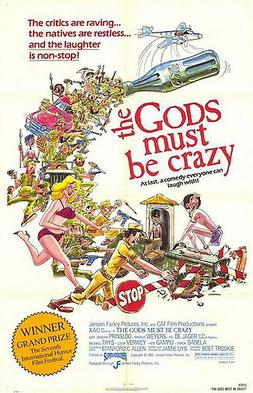
Plot and style
The narrative is simple and episodic: the protagonist's attempt to remove the bottle from his community sparks quarrels and launches him on a journey to return it to the gods. Intercut with that central thread are vignettes involving urban characters, slapstick mishaps, and scenes of local wildlife. The film's tone ranges from gentle satire to physical comedy, using silence, visual gags and cultural misunderstandings rather than lengthy dialogue.
Production and release
Directed by Jamie Uys, the film was shot on location in Southern Africa and features a mix of indigenous languages, Afrikaans and English. Its international distribution included a major United States release by 20th Century Fox; U.S. distribution helped the film reach a wide audience and contributed to its commercial success. For more about the director and production, see Jamie Uys, and for information on the American release see the U.S. distribution.
Reception, legacy and criticism
Upon release the film became an unexpected box‑office phenomenon outside its country of origin and for a time stood as one of the highest‑grossing foreign films in several markets. Its popularity introduced audiences worldwide to the lead actor and to images of Kalahari life, and it influenced other films that juxtapose traditional and modern worlds. At the same time, critics and scholars have pointed out problematic elements: the film's stereotyping of San people, simplistic contrasts between cultures, and occasional colonialist framing have prompted debate about representation and authorship.
Sequels and related works
- The original success led to a series of follow‑up films beginning in 1989. Some sequels were produced by different companies and varied in style and quality.
- According to release histories, four sequels appeared between 1989 and 1994; the later entries in the series involved production partnerships in Hong Kong and take a different, more commercial approach to the characters and comedy. See a note on sequels here.
The Gods Must Be Crazy remains a culturally significant film: widely seen and frequently referenced, it is both a landmark of international popular cinema and a work that raises enduring questions about cross‑cultural representation in mass entertainment.
Related articles
Author
AlegsaOnline.com The Gods Must Be Crazy (1980 film) Leandro Alegsa
URL: https://en.alegsaonline.com/art/98059