
Ten North Frederick (1958 film)
1958 American drama film adaptation of John O'Hara's novel, directed by Philip Dunne and starring Gary Cooper. Examines family, politics and personal ambition in mid‑20th century America.
Ten North Frederick is a 1958 American drama film adapted from the 1955 novel of the same name by John O'Hara. Released by 20th Century Fox, the picture explores themes of family conflict, political ambition and the personal costs of social expectation in a mid‑century small‑town setting. It features a leading performance by Gary Cooper and a supporting ensemble drawn from stage and screen.
Image gallery
1 Image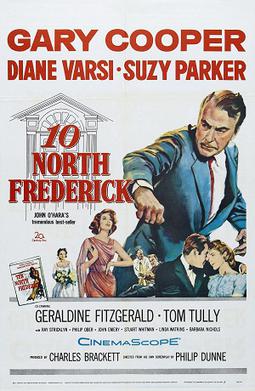
Overview
The film was produced during the studio era and presented as a character‑centered drama rather than a genre picture. Philip Dunne, who had a long career in Hollywood as a screenwriter and occasional director, brought the story from page to screen at a time when literary adaptations frequently formed a bridge between popular fiction and mainstream cinema. The screenplay adapts O'Hara's novelistic portrait of social life and private compromise, retaining the work's emphasis on interpersonal tension and the pressures of ambition.
Plot and themes
Rather than a plot‑driven thriller, Ten North Frederick focuses on interpersonal dynamics within a prominent family and on the public and private ambitions that shape their choices. Central themes include the conflict between public image and private failure, the burdens of expectation placed on heirs and spouses, and the ways in which political and social advancement can erode personal relationships. The film uses domestic scenes and character encounters to sketch a portrait of moral compromise and regret.
Cast
- Gary Cooper as the principal figure around whom the family drama revolves.
- Geraldine Fitzgerald, a key supporting performer who portrays a member of the embattled family.
- Tom Tully, Stuart Whitman, Stuart Whitman (credited among the younger players), Suzy Parker, Ray Stricklyn and Philip Ober in principal supporting roles.
Production and release
Produced and distributed by 20th Century Fox, Ten North Frederick arrived in theaters in 1958. The studio positioned it as a serious dramatic adaptation aimed at adult audiences interested in character studies and social commentary. Production values and casting underscored the studio's intent to present a polished, actor‑driven piece rather than a spectacle.
Reception and legacy
Contemporary critics and later commentators have tended to view the film through two lenses: as a condensed cinematic version of O'Hara's more expansive novel and as a showcase for its lead actors. Reviews at the time were mixed—praised in some quarters for performances and period detail, critiqued in others for the limitations inherent in compressing a dense novel into feature length. Today the film is of interest to students of mid‑century American cinema, adaptations of literary fiction, and the careers of its principal cast and director.
Ten North Frederick remains an example of 1950s Hollywood attempts to translate socially focused novels to the screen, balancing studio constraints with a desire to engage serious themes. For further reading on the novel and its adaptation, consult sources on John O'Hara and mid‑century American film adaptations.
Questions and answers
Q: When was Ten North Frederick movie released?
A: Ten North Frederick movie was released in 1958.
Q: Who directed Ten North Frederick movie?
A: Philip Dunne directed Ten North Frederick movie.
Q: What is the basis of Ten North Frederick movie?
A: The basis of Ten North Frederick movie is the 1955 book of the same name by John O'Hara.
Q: Who are the actors in the Ten North Frederick movie?
A: Actors in the Ten North Frederick movie include Gary Cooper, Geraldine Fitzgerald, Tom Tully, Stuart Whitman, Suzy Parker, Ray Stricklyn, and Philip Ober.
Q: Which movie production company distributed Ten North Frederick movie?
A: Ten North Frederick movie was distributed by 20th Century Fox.
Q: What genre does Ten North Frederick movie belong to?
A: Ten North Frederick movie belongs to the drama genre.
Q: What is the runtime of Ten North Frederick movie?
A: There is no information provided about the runtime of Ten North Frederick movie.
Related articles
Author
AlegsaOnline.com Ten North Frederick (1958 film) Leandro Alegsa
URL: https://en.alegsaonline.com/art/96944