
Table football (foosball): overview, equipment, history and competitive play
Table football, also called foosball or table soccer, is a tabletop game inspired by association football. This article explains equipment, play formats, history, competitive scene, and regional variations.
Overview
Table football is a tabletop game that simulates association football using small player figures mounted on rotating rods. Known variously as table soccer, table football, or foosball, it can be played one-on-one (singles) or two-on-two (doubles) and ranges from a casual pastime to an organized sport with formal tournaments. The English term "foosball" derives from the German word for football, fussball, reflecting the game's European roots.
Image gallery
9 Images



Equipment and main components
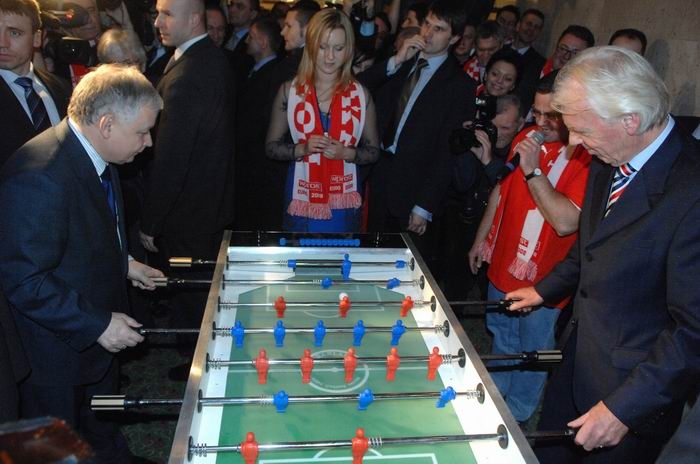
Tables vary in size and quality but share a common layout: a playing surface, eight or more metal rods, plastic or wooden player figures, goals, and a scoring mechanism. Key elements include:
- Playing surface: typically smooth and hard to allow consistent ball roll; some surfaces are coated or textured for speed control.
- Rods and bearings: rods can be hollow or solid, with bearings or bushings that affect responsiveness and durability.
- Player figures: attached to rods in tactical formations (for example, 1-2-5-3 or 1-3-4-3), made from plastic, metal, or wood.
- Goalie systems: single-man goalies, three-man defensive bars, or goalies on a separate rod depending on table design.
- Ball: usually hard plastic, cork, or composite; weight and texture change ball behavior.
Table grades and differences
Tables are broadly categorized as home-grade or professional-grade. Home-grade units emphasize affordability, compactness, and safety for children and casual players. Professional-grade tables prioritize precision: heavier frames, responsive bearings, calibrated playing surfaces, and durable rods to endure competitive play and provide better ball control. Regional manufacturers often introduce design features reflecting local playing styles and rules.
Gameplay, rules and formats
Basic play revolves around scoring goals by maneuvering the ball with controlled passes and shots from the rods. Standard formats include singles (two players) and doubles (four players). Common rules govern serving, dead balls, spinners and ball-in-play procedures, and match scoring, though variations exist among casual groups and tournament federations. Skillful play emphasizes ball control, passing sequences, and accurate shooting rather than brute force.
History and development
The exact origin of table football is diffuse: versions of tabletop football appeared in Europe and North America in the late 19th and early 20th centuries, with several inventors and hobbyists contributing designs. The game gained popularity after World War II as mass-produced tables became affordable. Over decades, clubs, national associations and international federations emerged to standardize equipment and rules for competition.
Competitive play, culture and variations
Foosball today includes local club nights, national championships and international tournaments organized by various governing bodies. Competitive play has produced specialist techniques for ball control, passing systems and defensive formations. Variants of the table—such as coin-op pub tables, lightweight portable units, or highly engineered tournament tables—create distinct playing experiences. Aside from sport, table football remains a social activity in bars, game rooms and offices, prized for fast-paced action and accessibility to beginners and experts alike.
Notable distinctions
- Terminology: "foosball" is common in the United States, while "table football" or "table soccer" is preferred elsewhere.
- Table design: small details—rod feel, surface friction, and player shape—significantly change game strategy.
- Play culture: casual play focuses on fun and socializing; competitive scenes stress standardized rules and equipment.
Related articles
Author
AlegsaOnline.com Table football (foosball): overview, equipment, history and competitive play Leandro Alegsa
URL: https://en.alegsaonline.com/art/95795