
Stanley Smith Stevens: psychologist, psychophysicist, and measurement theorist
American psychologist Stanley S. Stevens (1906–1973) advanced psychophysics with Stevens' power law, formalized measurement scales, founded Harvard's Psycho-Acoustic Laboratory, and edited the Handbook of Experimental Psychology.
Stanley Smith Stevens (4 November 1906 – 18 January 1973) was an American psychologist who played a central role in the development of modern psychophysics and experimental methods in psychology. He is widely remembered for formulating Stevens' power law, for advocating magnitude estimation and other scaling procedures, for articulating a practical taxonomy of measurement, and for founding and directing facilities at Harvard devoted to psychoacoustics. Stevens also edited the extensive Handbook of Experimental Psychology (1951), which collected methods and results across laboratory psychology.
Image gallery
1 Image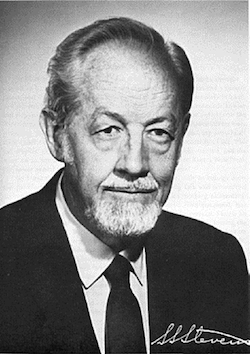
Major contributions
Stevens proposed that perceived magnitude of many sensory attributes can be described by a power function of stimulus intensity; the exponent varies across sensory modalities, producing different subjective growth rates for loudness, brightness, weight, and other sensations. To test scaling relations he developed experimental techniques such as magnitude estimation, where observers assign numbers proportional to perceived intensity. These methods shifted emphasis away from simple threshold measures toward continuous, quantitative descriptions of sensation and perception.
Scales of measurement
Beyond sensory scaling, Stevens is commonly credited with clarifying how different types of data should be treated through a practical taxonomy of measurement levels. His classification is taught widely and remains influential in research design and statistics. The four levels are:
- Nominal — categories distinguished by name only (for example, diagnostic categories or blood types).
- Ordinal — ranked data that convey order but not consistent intervals (for example, competition places or survey ranks).
- Interval — ordered values with equal intervals but without a true zero point (for example, temperature in Celsius).
- Ratio — interval scale with a meaningful zero allowing ratio comparisons (for example, length or mass).
Work in psychoacoustics and experimental psychology
At Harvard Stevens established laboratories that emphasized precise stimulus control, careful measurement and replication. His psychoacoustic work examined how humans detect and scale sound attributes such as loudness and pitch, and his laboratories developed apparatus and protocols to support rigorous experiments. The Handbook of Experimental Psychology, which he edited, assembled chapters on methods, instrumentation, and empirical findings and became a standard mid-20th-century reference for students and researchers.
Reception and legacy
Stevens' work influenced not only laboratory psychophysics but also applied areas such as education, marketing, and the social sciences through his scaling methods and measurement distinctions. His power-law description prompted debate about its generality relative to earlier logarithmic models (for example, Fechner's law) and about the limits of numerical scaling for complex judgments. His taxonomy of measurement levels has been critiqued and refined in subsequent methodological literature, yet it remains a practical tool for choosing summary statistics and tests. For an accessible biographical overview see this profile, and for more detailed discussions of psychophysical scaling and methods consult specialized sources here or the original discussions of Stevens' power law.
Stevens' combination of experimental innovation, methodological clarification and editorial leadership helped shape twentieth-century experimental psychology. While debates about interpretation and scope continue, many researchers still rely on the measurement distinctions and scaling procedures he promoted when designing experiments and interpreting behavioral data.
Related articles
Author
AlegsaOnline.com Stanley Smith Stevens: psychologist, psychophysicist, and measurement theorist Leandro Alegsa
URL: https://en.alegsaonline.com/art/93388
Sources
- books.nap.edu : Biographical Memoirs
- jstor.org : American Journal of Psychology
- web.mit.edu : International encyclopedia of the social & behavioral sciences