
Signs of Life (1968 film)
Signs of Life (German: Lebenszeichen) is Werner Herzog's debut feature (1968), an adaptation of an Achim von Arnim tale exploring isolation, madness, and authority; it won a German Film Award.
Signs of Life (German: Lebenszeichen) is the first feature film written, produced and directed by Werner Herzog, released in 1968. Loosely adapted from the short story "Der tolle Invalide auf dem Fort Ratonneau" by Achim von Arnim, the film established themes and stylistic choices—loneliness, obsession, sparse dialogue and striking landscape imagery—that would recur throughout Herzog's career.
Image gallery
1 Image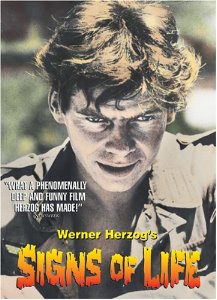
Overview
The narrative follows the psychological unravelling of a soldier stationed at a remote fortress during wartime. Rather than focusing on action or conventional plot mechanics, the film concentrates on mood, character dislocation and the mounting tension between military routine and personal collapse. Herzog employs long, contemplative shots and a deliberate pace to create an atmospheric study of human fragility.
Production and style
Made on a modest budget, Signs of Life was shot largely on location and uses austere environments to heighten the sense of isolation. The film's aesthetic—natural light, careful framing and an emphasis on landscape as character—helped define the director's visual voice. Performances are restrained, and the storytelling foregrounds psychological detail over explicit exposition.
Themes and interpretation
- Isolation and the effects of confinement on the mind.
- Authority, duty and the thin line between discipline and madness.
- The interplay between environment and inner life.
Critics and viewers have read the movie as both a wartime parable and a broader meditation on how extreme circumstances can erode identity.
Reception and legacy
Upon release, the film received attention in West Germany and abroad and won a German Film Award, helping to launch Herzog's international career. While more austere than many commercial films of the era, its success signalled an appetite for personal, auteur-driven cinema and marked the arrival of a distinct directorial talent.
Notable facts
- Signs of Life is Herzog's first full-length feature and is frequently cited as the starting point of his mature work.
- The screenplay adapts a Romantic-era short story, but shifts emphasis to psychological realism over period detail.
- Its influence is seen in later films that explore the relationship between humans and unforgiving landscapes.
For further reading on the film's production and place in Herzog's oeuvre, consult comprehensive film studies or director-focused retrospectives available through scholarly and film-archive resources.
Related articles
Author
AlegsaOnline.com Signs of Life (1968 film) Leandro Alegsa
URL: https://en.alegsaonline.com/art/90339