
Sierpinski triangle: construction, properties, and significance
A classic self-similar fractal formed by repeatedly removing central triangles from an equilateral triangle. Notable for its simple rule, Hausdorff dimension log 3 / log 2 ≈ 1.585 and zero area.
Overview
The Sierpinski triangle (also called the Sierpinski gasket) is a geometric figure that illustrates the idea of self-similarity: the whole is built from smaller copies of itself. It is produced by a simple iterative removal process applied to an initial equilateral shape and is a standard example of a fractal used in mathematics, computer graphics and pedagogy.
Image gallery
7 Images





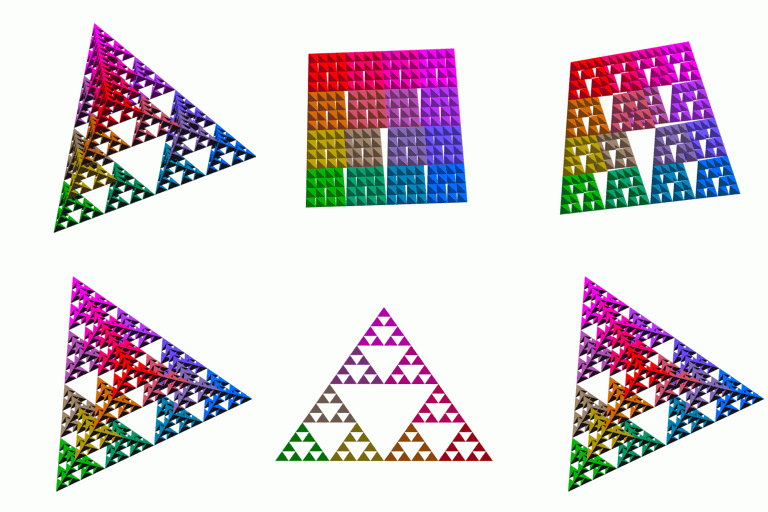
Construction
One common deterministic construction begins with an equilateral triangle and repeats the following step indefinitely:
- Subdivide the triangle into four congruent equilateral triangles by connecting the midpoints of its sides.
- Remove the central (inverted) triangle, leaving three corner triangles.
- Apply the same removal procedure to each remaining smaller triangle, and so on.
After n iterations the figure consists of 3^n small equilateral triangles of side length 2^{-n} times the original. The same fractal can also be generated by random methods (the "chaos game") in which one repeatedly moves halfway toward a randomly chosen vertex of the original triangle.
Mathematical properties
The Sierpinski triangle is self-similar: it is exactly the union of three scaled copies of itself, each scaled by factor 1/2. Its Hausdorff (fractal) dimension is log 3 / log 2 ≈ 1.585, which lies between the dimensions of a line and a plane. Although it contains an uncountable infinity of points, the planar Lebesgue area of the limiting set is zero because the remaining area after each step is multiplied by 3/4, and (3/4)^n tends to zero as n grows.
The boundary of the set becomes increasingly intricate with each iteration; the total edge length grows without bound. The Sierpinski triangle is compact, has empty interior in the plane, and is widely used to illustrate differences between topological and fractal dimensions.
History and variants
The shape is named after the Polish mathematician Wacław Sierpiński, who described related constructions in the early 20th century. Variants include the Sierpinski carpet (a square-based analogue) and three-dimensional generalizations such as the Sierpinski tetrahedron or tetrahedral gasket, which extend the same removal rule into space; see 3D versions for these analogues.
Examples, applications, and notable facts
Beyond serving as a pedagogical example, the pattern appears in surprising places: the pattern of odd and even entries in Pascal's triangle (when shaded modulo 2) reproduces the Sierpinski triangle; certain antenna designs exploit self-similar shapes for multi-band behavior; and artists and designers use its recursive motif for visual effect. The simplicity of its rule—remove a central piece repeatedly—makes the Sierpinski triangle an enduring and accessible gateway to fractal geometry.

Author
AlegsaOnline.com Sierpinski triangle: construction, properties, and significance Leandro Alegsa
URL: https://en.alegsaonline.com/art/90277
Sources
- math.rice.edu : "Cynthia Lanius' Fractals Unit: The Sierpinski Triangle"