
Severe acute respiratory syndrome coronavirus 2 (SARS-CoV-2)
SARS-CoV-2 is the coronavirus responsible for COVID-19. This article explains its classification, structure, early emergence, modes of transmission, public health impact and key distinctions.
Overview
SARS-CoV-2 is a member of the coronaviruses that infect humans and other animals. It is the pathogen that causes the illness known as COVID-19. The virus was first identified in late 2019 and rapidly spread worldwide, prompting coordinated responses from public health organizations such as the World Health Organization.
Image gallery
10 Images





Structure and genome
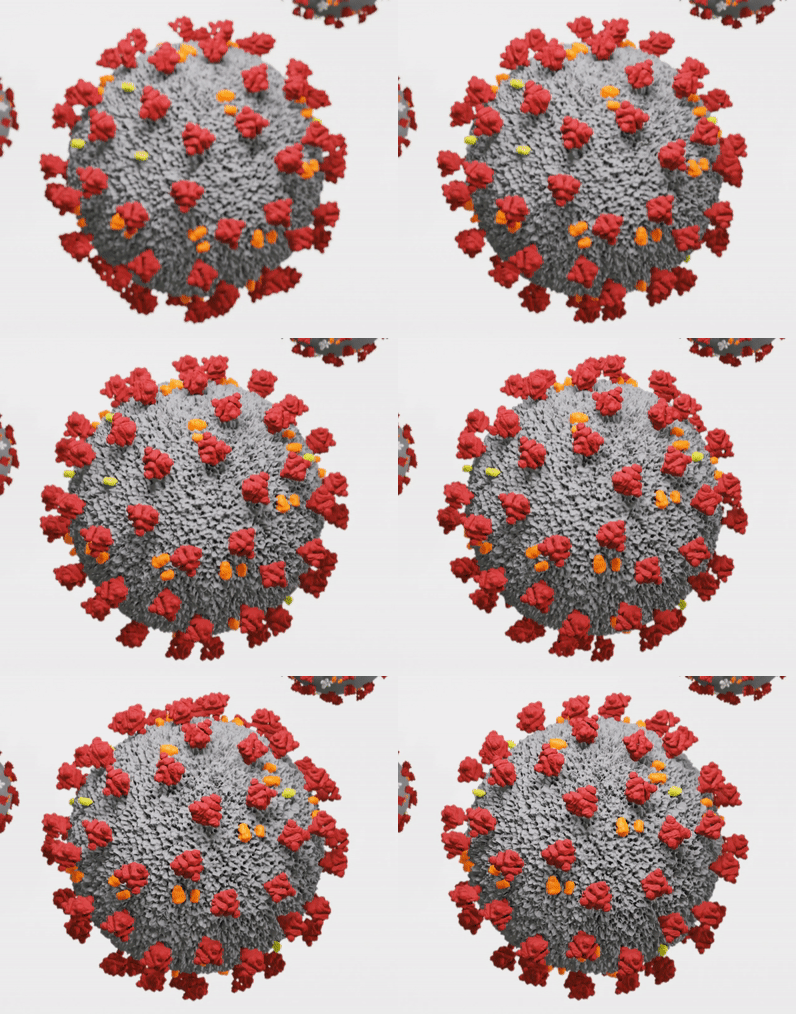
At the molecular level, SARS-CoV-2 is an enveloped virus with a genome composed of positive-sense, single-stranded RNA. It belongs to the group commonly referred to as coronaviruses. Characteristic surface spike proteins give the virion its crown-like appearance and mediate attachment to host cells. Key components include:
- Spike (S) protein that binds cellular receptors.
- Membrane (M) and envelope (E) proteins that shape the particle.
- Nucleocapsid (N) protein associated with the viral RNA genome.
History and emergence
Health authorities received the first reports of an unusual cluster of pneumonia cases in late 2019. Many early infections were epidemiologically linked to a market in Wuhan, China, though the precise pathway by which the virus first began infecting people remains under investigation. Multiple investigations have explored animal-to-human transmission and other scenarios; uncertainty over the initial source of the outbreak has been noted in studies and summaries of the origin of the pandemic.
Disease, transmission and clinical impact
SARS-CoV-2 infection ranges from asymptomatic to severe respiratory disease. It primarily spreads through respiratory droplets and aerosols produced when infected people breathe, speak, cough or sneeze. Transmission can also occur indirectly via contaminated surfaces, although this is not the main route. The clinical syndrome COVID-19 affects the respiratory system and can involve other organs; risk of severe illness increases with age and certain underlying medical conditions.
Variants, response and notable facts
The virus has evolved into multiple genetic variants since its emergence. Some variants showed differences in transmissibility, immune escape or disease severity, which influenced public health measures, vaccine development and treatment strategies. Global surveillance, vaccination, non-pharmaceutical interventions and clinical research have been central to controlling spread and reducing severe outcomes. Continued monitoring and scientific study remain important to understand long-term effects and future risks.
Distinctions and significance
SARS-CoV-2 is distinct from earlier human coronaviruses by its particular genetic sequence, epidemiological behavior and the scale of its global impact. Its rapid spread highlighted the importance of international coordination in infectious disease detection, data sharing, and vaccine deployment.
positive-sense reference | single-stranded RNA reference | coronavirus reference | COVID-19 reference | WHO reference | Wuhan reference | origin discussion
Questions and answers
Q: What is SARS-CoV-2?
A: SARS-CoV-2 is a positive-sense, single-stranded RNA coronavirus which causes the disease COVID-19.
Q: How was it known before?
A: It used to be known as 2019 novel coronavirus (2019-nCoV) by the World Health Organization (WHO).
Q: When were the first suspected cases reported?
A: The first suspected cases were reported to the WHO on December 31, 2019.
Q: Where did many early cases of this new coronavirus originate from?
A: Many early cases of this new coronavirus were linked to Huanan Seafood Wholesale Market, a large seafood and animal market in Wuhan, China.
Q: Is it certain that this place was the source of the pandemic?
A: No, it is not certain that this place was the source of the pandemic.
Q: What type of virus is SARS-CoV-2?
A: SARS-CoV-2 is a positive sense single stranded RNA coronavirus.
Q: What started the 2019–20 coronavirus outbreak?
A: The virus started the 2019–20 coronavirus outbreak.
Author
AlegsaOnline.com Severe acute respiratory syndrome coronavirus 2 (SARS-CoV-2) Leandro Alegsa
URL: https://en.alegsaonline.com/art/89225
Sources
- time.com : "What's in a Name? Why WHO's Formal Name for the New Coronavirus Disease Matters"
- who.int : "Surveillance case definitions for human infection with novel coronavirus (nCoV)"
- cdc.gov : "Novel coronavirus (2019-nCoV), Wuhan, China"
- chinacdc.cn : "中国疾病预防控制中心"
- xinhuanet.com : "New-type coronavirus causes pneumonia in Wuhan: expert"
- platform.gisaid.org : "CoV2020"
- who.int : "Pneumonia of unknown cause – China. Disease outbreak news" · web.archive.org
- cidrap.umn.edu : "Report: Thailand's coronavirus patient didn't visit outbreak market" · web.archive.org
- nj.gov : "Update and Interim Guidance on Outbreak of 2019 Novel Coronavirus (2019-nCoV) in Wuhan, China CDC Health Update"
- biorxiv.org : "Discovery of a novel coronavirus associated with the recent pneumonia outbreak in humans and its potential bat origin"
- doi.org : 10.1101/2020.01.22.914952
- ncbi.nlm.nih.gov : CoVZC45
- ncbi.nlm.nih.gov : CoVZXC21