
Rugrats: overview, history, characters, films and cultural impact
An encyclopedia-style account of Rugrats, the Nickelodeon animated series about toddlers' adventures, covering premise, production history, films, spin-offs, themes, and its broader legacy.
Rugrats is an American animated television series created by Arlene Klasky, Gábor Csupó and Paul Germain and produced by Klasky Csupo for Nickelodeon. Told largely from the point of view of infants and toddlers, the show follows a small ensemble of young children whose ordinary experiences—visiting the park, meeting a new sibling, or a family holiday—are reframed in expansive, imaginative adventures. Central characters include Tommy Pickles, the curious and brave leader; his cautious friend Chuckie Finster; twins Phil and Lil DeVille; Angelica Pickles, the outspoken older cousin; and a rotating supporting cast such as Susie Carmichael, Dil Pickles and Kimi Finster.
Image gallery
6 Images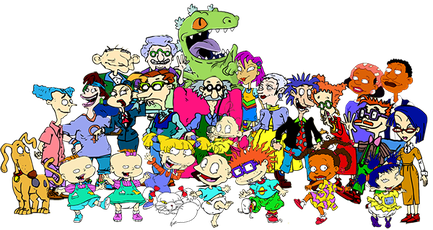



Premise and distinctive style
The series is built on a simple formal conceit: everyday events are filtered through the children's limited understanding and vivid imaginations. Visual and narrative devices—oversized household objects, exaggerated peril, and fantasy interludes—turn routine moments into dramatic stories. Episodes often juxtapose a toddler's internal world with adults' more mundane interpretations, producing humor for both child and adult viewers. The show is known for its warm-but-edgy hand-drawn look, lively character designs and a soundscape that mixes domestic details with adventurous cues.
Production and broadcast history
Rugrats premiered on August 11, 1991 as one of the original Nicktoons. Early production produced 65 episodes across three seasons before a production pause in 1993. Two holiday-themed episodes, "A Rugrats Passover" and "A Rugrats Chanukah", were produced and aired in the mid-1990s and received attention for their respectful presentation of Jewish traditions within a mainstream children's series. During the mid-1990s the program benefited from heavy rotation on Nickelodeon, which raised its profile and ratings through constant reruns. New episodes resumed in 1997 and the series ultimately ran nine seasons, producing a total of 172 episodes before the final original broadcast in 2004.
Films, specials and spin-offs
Rugrats expanded into feature films and television specials as its popularity grew. A 10th-anniversary TV special, "All Growed Up", explored the characters as preteens and served as the pilot for the later series All Grown Up!, which ran from 2003 to 2008. The theatrical films include several high-profile releases and introduced new characters:
- The Rugrats Movie (1998) — a theatrical debut that introduced Tommy's baby brother, Dil Pickles.
- Rugrats in Paris: The Movie (2000) — which introduced Kimi and expanded family storylines.
- Rugrats Go Wild (2003) — a crossover feature with another Klasky Csupo series, The Wild Thornberrys.
Additional direct-to-video specials and a brief spin-off, Rugrats Pre-School Daze, further extended the franchise alongside toys, video games, comics and other licensed products.
Themes, audience and critical reception
Rugrats addressed themes of family, friendship, sibling rivalry and cultural traditions while targeting a dual audience: children who enjoyed the surface-level adventures and adults who appreciated the show's wit and often affectionate satire of parenting. The series was praised for bringing holiday and cultural narratives to mainstream children's television and for portraying diverse family arrangements. Critics and award panels recognized the program's quality; during its run it received multiple Daytime Emmy Awards, Kids' Choice Awards and other honors, and it earned a star on the Hollywood Walk of Fame.
Legacy and later developments
Rugrats became one of Nickelodeon's signature properties, anchoring the network's ratings in the 1990s and helping define the Nicktoons brand. Its long run and franchise extensions made it one of the longest-running American animated series of its era. In 2001 the "All Growed Up" special led to the All Grown Up! series, and the property was later revisited with a reimagined series produced for streaming platforms; an official reboot produced by the original creative team premiered on Paramount+ in 2021. Beyond broadcast, Rugrats influenced how children's shows could combine child-centered perspective with cross-generational humor, and it remains a frequent reference point in discussions of 1990s animation and youth culture.
Notable distinctions: the program tied for one of the longest continuous runs among U.S. animated series of its time, won numerous industry awards, and sustained a wide merchandising presence that kept the characters in public view long after regular production ended.
Related articles
Author
AlegsaOnline.com Rugrats: overview, history, characters, films and cultural impact Leandro Alegsa
URL: https://en.alegsaonline.com/art/84668
Sources
- newyorker.com : "You Dumb Babies"
- tvguide.com : "Watch Rugrats Episodes : Season 9"
- articles.latimes.com : "'Rugrats,' 'All That' Win Kids' Awards"