
Roswell UFO Incident: 1947 crash, explanations, and cultural impact
Overview of the 1947 Roswell incident: discovery of debris near Roswell, New Mexico; military statements and later investigations; conspiracy theories and its influence on popular culture.

Overview
In July 1947 a rancher discovered unusual debris on land near a ranch outside Roswell, New Mexico. The U.S. military initially issued a statement that referred to a "flying disc" but quickly retracted it and said the material came from a weather balloon. The conflicting early reports and later stories alleging recovered bodies helped make the episode a focal point for claims that a UFO or alien spacecraft had crashed and that authorities covered up the truth.
Image gallery
10 Images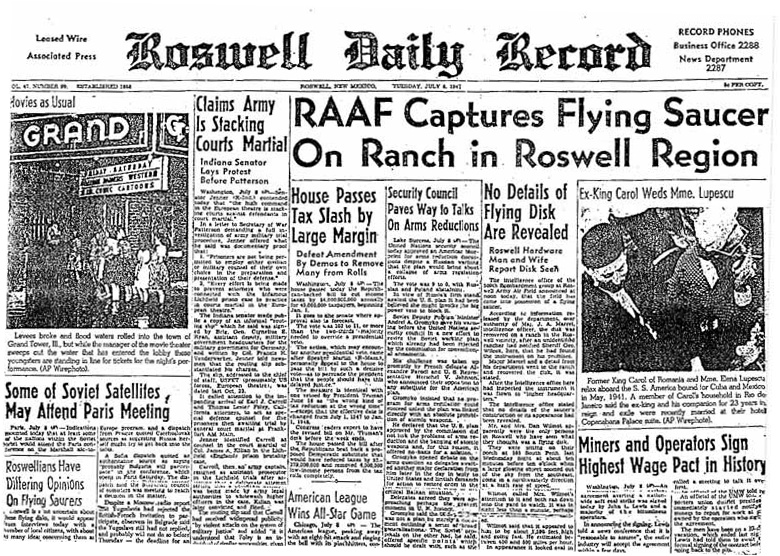


Key events and eyewitness accounts
- Discovery of scattered metallic and rubbery materials on ranchland in mid-1947.
- Military recovery of debris and an initial press release mentioning a possible "disc."
- Rapid retraction and an official explanation of a conventional balloon.
- A resurgence of public interest decades later, when witnesses and authors presented accounts of a more dramatic crash and alleged recoveries of non-human bodies.
Official explanations and investigations
Over time several official reviews were published. The United States Air Force revisited the matter and concluded that debris most likely belonged to a classified atmospheric monitoring program known as Project Mogul, whose materials and structure could appear unusual to observers. Later reviews addressed claims about autopsy films and alien bodies, identifying inconsistencies, misidentifications, and hoaxes among the available sources. These official reports did not satisfy all researchers or witnesses, and debates continue about the reliability of recollections and the possibility of deliberate secrecy during the early Cold War era.
Why it endures
The Roswell incident remains prominent because it combines several elements that encourage speculation: early contradictory statements from authorities, later testimony that changed over time, limited public access to some Cold-War-era programs, and a wider cultural appetite for extraterrestrial explanations. The story has inspired books, films, television programs, museums, and an annual tourism industry in the town of Roswell. It serves as a case study of how unusual events can be amplified into enduring modern folklore.
Notable distinctions and significance
Two points are important when considering Roswell. First, most mainstream researchers and official inquiries identify terrestrial sources—military projects and conventional debris—as the simplest explanations for the recovered materials. Second, the incident illustrates how memory, media, and mistrust of institutions can transform uncertain facts into firm claims over decades. While no verified physical evidence of an extraterrestrial spacecraft has been widely accepted by the scientific community, Roswell continues to shape public perceptions of UFOs and government transparency.
For further context, contemporary source material and later analyses can be explored through archival records and specialized studies that examine both the original reports and the cultural legacy of the event.
Related articles
Author
AlegsaOnline.com Roswell UFO Incident: 1947 crash, explanations, and cultural impact Leandro Alegsa
URL: https://en.alegsaonline.com/art/84249