
Pitch (baseball): rules, mechanics, types, history and strategy
A pitch in baseball is the delivery of the ball by the pitcher to the batter. This article explains rules for balls and strikes, how pitches are thrown, common pitch types, historical development, and strategic roles.
Overview
A pitch is the fundamental act in baseball in which the pitcher throws the baseball toward the batter at home plate. The pitcher’s objective is to retire the batter or otherwise benefit the defense by inducing weak contact, a missed swing, or a called ball that leads to favorable situations. Each pitch is governed by rules about the strike zone, balls and strikes, and how the ball is delivered; the catcher, umpire and batter all have roles that interact with the pitch.
Image gallery
3 Images

Rules and game outcomes
When a pitch is delivered, it is judged a strike or a ball according to the strike zone and the batter’s action. A strike can occur when a pitch passes through or sufficiently over the strike zone without the batter swinging, when the batter swings and misses, or when the batter makes a foul tip that is caught by the catcher. A batter who accumulates three strikes is out. A ball is a pitch that does not pass through the strike zone and is not swung at; four balls award the batter a walk to first base. Variations and specific interpretations of the strike zone exist, but its vertical limits are commonly described as the area from around the batter’s knees to roughly the midpoint of the torso, and horizontally the width of home plate.
Mechanics and parts of a pitch
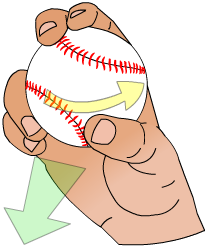
Every pitch has several mechanical elements: the grip on the ball, the pitcher’s arm slot and delivery (overhand, three-quarters, sidearm, or submarine), the release point, and the spin imparted to the ball. These factors determine velocity, movement and deception. Velocity measures how fast the ball travels; movement describes how the ball deviates from a straight line, influenced by spin and seam orientation; deception comes from arm speed, release timing and how closely the pitcher’s motion resembles other pitch types. Catchers typically signal which pitch to throw and where to locate it, forming a tactical partnership with the pitcher.
Common pitch types
Pitchers employ a repertoire of pitches to vary speed and movement and to exploit hitters’ weaknesses. Common categories include:
- Fastball — Thrown with maximal arm speed; prioritizes velocity and backspin to resist downward drop.
- Changeup — A slower pitch with similar arm action to the fastball, designed to disrupt timing.
- Curveball — Generates large downward and lateral break through topspin and wrist action.
- Slider — A sharper, later-breaking pitch between a fastball and curveball in speed and motion.
- Cutter and sinker — Fastballs with late horizontal or downward movement to induce weak contact.
- Knuckleball — An unpredictable, low-spin pitch that moves erratically and is difficult to control.
History and development
Pitching evolved substantially since baseball’s earliest days. Initially pitches were delivered underhand as a means to initiate play; as competitive play advanced, pitchers began to experiment with speed, spin and arm angles to gain advantage. Rule changes and cultural shifts in the late 19th and early 20th centuries gradually allowed higher and more forceful deliveries, and innovations in grips and mechanics produced the diverse pitch types used today. Over time, statistical study and improved measurement (such as radar and high-speed tracking) have influenced how pitchers train and select pitches.
Strategy, roles, and notable considerations
Pitching is as strategic as it is physical. Teams designate starting pitchers to throw multiple innings and relief pitchers who specialize in short stints; closers are often used to finish tight games. Pitch selection depends on the count, batter tendencies, game situation and ball-strike location. Advanced measures—velocity, spin rate, release point and pitch sequencing—are now standard in game planning and scouting. Pitching also carries injury risk: arm and shoulder health govern long-term effectiveness, leading to pitch counts, innings limits, and medical monitoring for young and professional players.
For a concise summary of the official definitions and rulebook language that govern balls, strikes, and pitching deliveries, see the official rules. Understanding the pitch combines the physical craft of throwing with tactical decision-making and a long history of innovation that keeps the duel between pitcher and batter central to the game.
Related articles
Author
AlegsaOnline.com Pitch (baseball): rules, mechanics, types, history and strategy Leandro Alegsa
URL: https://en.alegsaonline.com/art/77119
Sources
- associatedcontent.com : "Guide to the Different Types of Pitches in Baseball"