
New York Herald (1835–1924)
A major 19th‑ and early‑20th‑century New York City daily founded by James Gordon Bennett Sr.; noted for large circulation, sensational reporting, political influence, and international editions.
The New York Herald was a prominent daily newspaper published in New York City from 1835 until 1924. Established by James Gordon Bennett, Sr., it rose quickly to national prominence and by the mid‑19th century ranked among the most widely read newspapers in the United States. The Herald combined a strong emphasis on timely reporting with vivid prose and bold headlines; under its founder it became known for a vivid, attention‑grabbing style summed up by Bennett's remark that the business of newspapers "is not to instruct but to startle."
Image gallery
6 Images
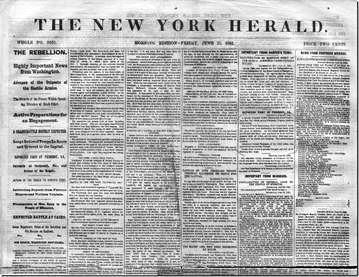


Editorial character and content
The Herald's pages mixed political dispatches, crime and court reporting, commerce and shipping news, foreign correspondence, and human‑interest stories. Its approach favored immediacy and spectacle: extended front‑page reports, descriptive accounts of events, and a willingness to highlight scandal or conflict. That tone helped the Herald attract a mass readership and set stylistic patterns later associated with popular or sensational journalism.
History and development
James Gordon Bennett, Sr. launched the paper in 1835 and guided its early expansion. Within a decade the Herald had become one of the most purchased dailies in America, and by 1861 it promoted itself as "the most largely circulated journal in the world," reporting substantial daily sales. Leadership later passed to Bennett's heirs, who maintained the paper's distinctive voice and extended its reach by establishing editions abroad. The Herald's operations and editorial identity evolved through the 19th century as reporting technologies, distribution networks, and political debates changed the media landscape. In 1924 the Herald's independent run ended when it joined with other titles to form a successor paper, marking the close of its direct publication history while its editorial lineage persisted in later newspapers and international editions.
Importance and legacy
The New York Herald played several influential roles in American journalism. It demonstrated the commercial potential of high circulation achieved through accessible, vivid news coverage. Its investment in broad, round‑the‑clock reporting and in foreign dispatches helped popularize the idea that newspapers should cover both local and international events for a mass audience. The Herald's style and business model influenced competing New York papers and anticipated features of later popular press movements.
Notable distinctions
- Founder: James Gordon Bennett, Sr., noted for his combative editorial voice and entrepreneurial instincts.
- Circulation: By mid‑century the paper claimed national prominence and large daily sales for its era.
- Political posture: Under Bennett the Herald often reflected a partisan outlook, with documented criticisms of Catholicism and a Democratic‑leaning stance during the Civil War period.
- Style and influence: Recognized as one of the most sensational of its leading contemporaries, it served as a precursor to later mass‑market newspaper practices.
- Later history: The Herald's name and international offshoots contributed to successor publications and to a lineage of papers with global reach.
Because of its size and prominence, the New York Herald remains a significant subject for students of American media, urban culture, and political communication in the 19th and early 20th centuries. For more detailed archival material and reproductions of its pages consult specialized newspaper collections and historical repositories that preserve nineteenth‑century press output.
Related articles
Author
AlegsaOnline.com New York Herald (1835–1924) Leandro Alegsa
URL: https://en.alegsaonline.com/art/69663