
Asclepias subverticillata — horsetail (whorled) milkweed
A drought-tolerant milkweed native to the western United States, noted for thin, needlelike foliage, cream-green flowers, wind-dispersed seeds, and ecological importance to pollinators.
Asclepias subverticillata, commonly called horsetail milkweed or whorled milkweed, is a perennial species in the milkweed group. It belongs to the subfamily Asclepiadoideae within the dogbane family and is recognized for a slender, almost rush-like appearance that distinguishes it from broader-leaved milkweeds.
Image gallery
3 Images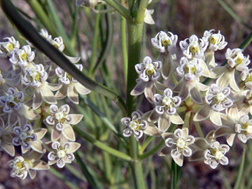


Characteristics
The plant produces erect, narrow stems with reduced or threadlike leaves arranged in a whorl or alternately along the stem, giving a horsetail silhouette. Flower clusters are compact and typically pale cream to greenish-white; like other milkweeds, the flowers have a specialized structure with pollinia (pollen masses) transferred by insects. After flowering it forms paired seed pods (follicles) that split open to release silk-tufted seeds carried by the wind.
Distribution and habitat
Native to the western United States and adjacent dry regions, this species favors open, well-drained sites such as prairies, sagebrush slopes, and rocky hillsides. It is adapted to arid and semi-arid climates and is valued for its drought tolerance in restoration and low-water landscaping.
Ecology, uses and cautions
- Ecological role: serves as a nectar source for bees and butterflies and as a larval host for monarchs and other milkweed-feeding species.
- Practical uses: used in xeriscaping and native-plant gardens to support pollinators and stabilize dry soils.
- Cautions: contains milky sap with cardiac glycosides that can be toxic to livestock and pets if consumed in large quantities.
Identification and similar species
Distinguishing features include the needlelike foliage and compact pale flower clusters; for comparison with other milkweeds see general milkweed references and basic plant identification guides. When planning plantings, consider local ecological conditions and the species' role in supporting native insects.
Author
AlegsaOnline.com Asclepias subverticillata — horsetail (whorled) milkweed Leandro Alegsa
URL: https://en.alegsaonline.com/art/6493