
Maple (computer algebra system)
Maple is a commercial computer algebra system by Maplesoft that integrates symbolic and numeric computation, visualization, a programming language, and tools for mathematics, engineering and education.
Overview
Maple is a commercial computer algebra system that combines symbolic computation, numerical analysis, visualization and a programmable environment. Originally developed from academic research at the University of Waterloo and commercialized by Maplesoft, Maple provides a unified interface for solving mathematical problems, prototyping models and creating interactive documents used in teaching, research and engineering.
Image gallery
5 Images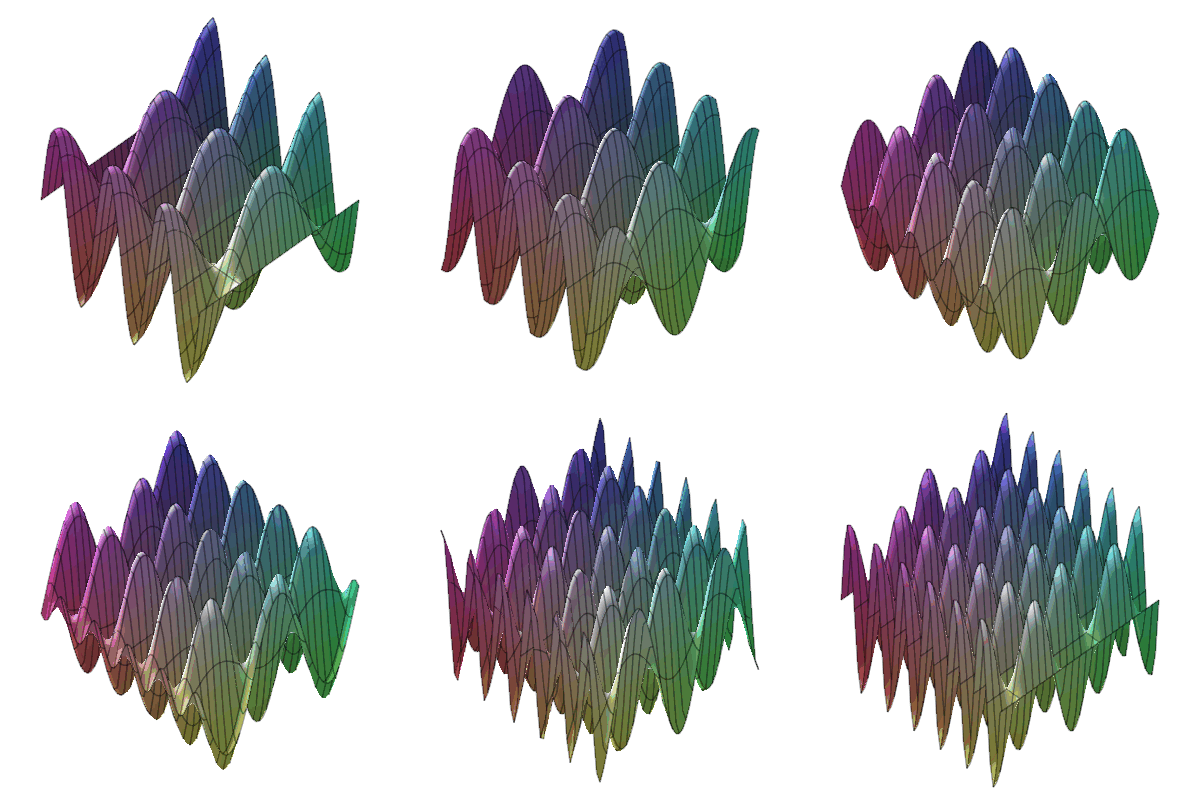


Core capabilities
- Symbolic computation: exact algebraic manipulation, simplification strategies, symbolic differentiation and integration, series expansions and manipulation of symbolic equations.
- Numeric computation: floating-point arithmetic with adjustable precision, numerical solvers for nonlinear systems, root-finding and optimization routines, and support for arbitrary-precision arithmetic where needed.
- Equations and calculus: tools for ordinary and partial differential equations, boundary value problems, transforms (Laplace, Fourier) and summation of series.
- Linear algebra and discrete math: dense and sparse matrix operations, eigenvalue computations, combinatorics and number-theoretic routines.
- Visualization: two- and three-dimensional plotting, animations and interactive manipulation of graphical output.
Architecture and language
Maple includes a high-level, dynamically typed programming language that supports procedural and functional programming styles, modular code organization and the creation of user-defined packages. The system integrates symbolic engines and numeric kernels so users can combine symbolic preprocessing with numerical evaluation. Worksheets and a document-style interface allow mixing of executable commands, formatted mathematics and explanatory text in the same file.
Interoperability and extensibility
Maple is extensible through add-on packages and toolboxes aimed at specialized domains. It provides mechanisms to call external routines written in languages such as C or Fortran, and to export or import mathematical expressions in common interchange formats used for publication and web presentation. Users can create libraries of algorithms, extend the language with new commands and connect Maple workflows to other tools often used in scientific computing.
History and development
Developed from work on symbolic and numeric computation at a Canadian university, Maple evolved into a mature commercial product and has been maintained and extended over several decades. The developer organization has released successive versions that enhanced algorithms, broadened the library of mathematical routines and improved the user interface for both classroom and professional use.
Applications and users
Maple is used in mathematics education for interactive demonstrations and homework systems, in research for symbolic-numeric investigations and algorithm development, and in industry for analytical preprocessing, prototyping and model exploration. It competes with other computational systems by offering a strong symbolic engine together with document-centric workflows.
Licensing and editions
Distributed as proprietary software, Maple is available under academic, commercial and trial licenses. Educational institutions commonly obtain campus or site licenses to support instruction and research; individual and enterprise licenses are offered for other professional uses.
Further notes
Because Maple integrates symbolic manipulation with numerical and visualization tools, it is commonly adopted where a single environment for derivation, verification and presentation of mathematical results is advantageous. Its combination of an algorithmic library, programmable language and interactive documents makes it useful across a wide range of scientific and engineering disciplines.
Related articles
Author
AlegsaOnline.com Maple (computer algebra system) Leandro Alegsa
URL: https://en.alegsaonline.com/art/61507