
Malcolm X (1992 film)
Spike Lee's 1992 biographical drama about the life of Malcolm X, starring Denzel Washington and Angela Bassett. Acclaimed for its performances and cultural impact; added to the U.S. National Film Registry in 2010.
Malcolm X is a 1992 film directed by Spike Lee. It is an American biographical drama that dramatizes the life of the African American leader Malcolm X. The picture stars Denzel Washington in the title role and features notable performances by Angela Bassett, Albert Hall, Al Freeman Jr., and Delroy Lindo. Public figures such as Al Sharpton and Nelson Mandela make cameo appearances, underscoring the film’s contemporary resonance.
Image gallery
2 Images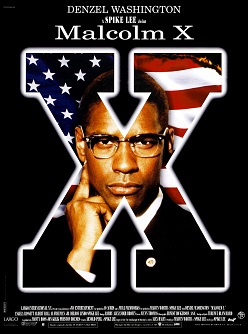

Scope and sources
The screenplay draws principally on Malcolm X’s own words as recorded in his autobiography with Alex Haley and on archival material to reconstruct key episodes of his life. The narrative follows his childhood and early encounters with racism, his involvement in criminal activity, imprisonment and conversion to the Nation of Islam, his emergence as a public figure and orator, his pilgrimage to Mecca and the consequent evolution of his views, and finally his assassination. The film blends dramatic reenactment with documentary footage to situate the story within broader historical currents.
Production and performances
Spike Lee’s direction emphasizes both personal biography and political context, aiming to portray the complexity of Malcolm X as a thinker and activist. Denzel Washington’s performance received wide critical acclaim and brought renewed attention to the role; Angela Bassett’s portrayal of Betty Shabazz was also widely praised. Supporting cast members contribute layered portrayals of figures who influenced Malcolm X’s life and career. The production is noted for its period detail, careful staging of public speeches, and use of archival elements to connect dramatization to documented events.
Reception, legacy and preservation
Upon release on November 18, 1992, the film earned positive reviews for its ambition, performances and cultural significance. It has been discussed extensively in film studies and civil rights history courses and has influenced public understanding of Malcolm X’s life. In 2010 the movie was selected for preservation in the United States National Film Registry by the Library of Congress as culturally, historically, or aesthetically significant. The film continues to be shown in retrospectives and educational settings, where it serves as a starting point for conversations about race, leadership, and American history.
Cast and notable facts
- Principal cast: Denzel Washington, Angela Bassett, Albert Hall, Delroy Lindo, and Al Freeman Jr..
- Produced and directed by Spike Lee, the film relied on extensive archival research and the autobiography as core sources.
- Premiered November 18, 1992 and received sustained critical attention for its scope and performances.
- Preserved in the U.S. National Film Registry for its lasting significance.
For readers seeking more on the film’s production, critical responses, and scholarly analysis, a range of reviews, interviews, and academic writings provide further context and interpretation. The film remains a prominent cinematic depiction of a complex historical figure and continues to provoke discussion about representation, historical memory, and the politics of biography in cinema.
Author
AlegsaOnline.com Malcolm X (1992 film) Leandro Alegsa
URL: https://en.alegsaonline.com/art/60988