
Arrondissements of the Ain department (France)
Overview of the four arrondissements that subdivide the Ain department in eastern France, their role, organization, geography and how they relate to communes and other administrative levels.
Overview
The Ain department in eastern France is divided into four arrondissements. Departments in the French administrative system are themselves part of regions and are commonly subdivided into arrondissements to organise state services and local administration. For a general introduction to the Ain department see Ain department, and for context about the system of French departments consult French departments.
Image gallery
1 Image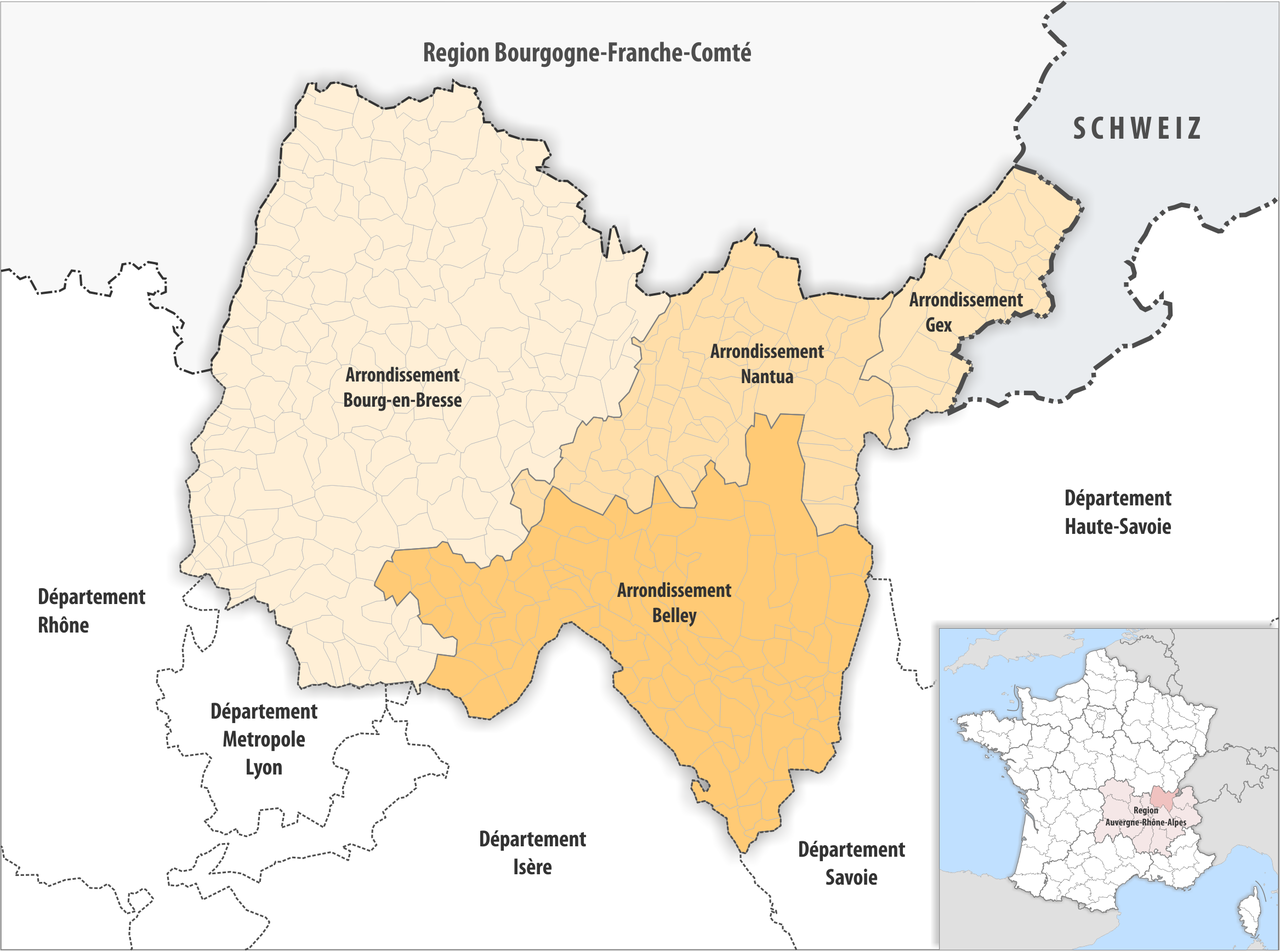
What is an arrondissement?
An arrondissement is a territorial subdivision used by the national government to coordinate public services below the departmental level. It is often translated in English as a district and sometimes as a borough; see arrondissements and the variant term borough. The administrative centre of an arrondissement is known as a subprefecture; when the department's prefecture lies within that arrondissement it performs both prefectural and subprefectural functions. Further information on these offices is available at prefecture and subprefecture.
Structure and relationship with communes
Arrondissements are composed of communes, the smallest local government units in France. Communes handle municipal matters while arrondissements largely serve to group communes for state administration and coordination. For an explanation of communes and local governance see communes and more general material at administrative divisions of France.
The four arrondissements of Ain
- Bourg-en-Bresse — the departmental prefecture and the capital of its arrondissement.
- Belley — an arrondissement centred on a historic town with rural and agricultural surroundings.
- Gex — located along the border with Switzerland, it includes the Pays de Gex area at the foot of the Jura.
- Nantua — covering parts of the Jura and upland landscapes toward the west of the department.
Geography, role and notable facts
The arrondissements of Ain encompass a varied landscape — from lowland plains and lakes to the Jura mountains and borderlands with Switzerland — and reflect historic regions such as the Dombes, Bugey and Revermont. While arrondissements have administrative importance for state services (police, education, certain permits), political representation and local government operate primarily through communes, cantons and the departmental council. The arrangement of arrondissements can change over time in response to administrative reforms or demographic shifts, but their core role remains facilitating the delivery of national services at a level closer to citizens.
Questions and answers
Q: How many arrondissements are there in the Ain department?
A: There are 4 arrondissements in the Ain department.
Q: What are arrondissements?
A: Arrondissements are districts or boroughs that French departments and other countries are divided into.
Q: What is the capital of an arrondissement called?
A: The capital of an arrondissement is called a subprefecture.
Q: If the prefecture of a department is in an arrondissement, what is the capital of the arrondissement?
A: If the prefecture of a department is in an arrondissement, that prefecture is the capital of the arrondissement, acting as both a prefecture and as a subprefecture.
Q: How are arrondissements further divided?
A: Arrondissements are further divided into communes.
Q: What is the name of the department that the Ain arrondissements reside in?
A: The Ain arrondissements reside in the Ain department.
Q: Can the term "districts" be used as a translation for arrondissements?
A: Yes, "districts" can be used as a translation for arrondissements.
Related articles
Author
AlegsaOnline.com Arrondissements of the Ain department (France) Leandro Alegsa
URL: https://en.alegsaonline.com/art/6092
Sources
- insee.fr : "Département de l'Ain (01)"
- insee.fr : "Régions, départements, arrondissements, cantons et communes"
- insee.fr : "Département de l'Ain (01) et Arrondissements"
- splaf.free.fr : "Historique de l'Ain"