
Ligeia — short story by Edgar Allan Poe
Encyclopedic entry on Edgar Allan Poe's Gothic tale "Ligeia": plot summary, characters, themes, composition and publication history, critical interpretations, and the notable film adaptation.
Overview
"Ligeia" is a Gothic short story by Edgar Allan Poe, first published in 1838 in The American Museum. The narrative is presented as the anguished first-person account of an unnamed narrator who describes his first wife, Ligeia, a woman of rare learning and fierce will. After Ligeia dies, having composed the poem later published as "The Conqueror Worm", the narrator marries Rowena of Trevanion. When Rowena appears to die, the narrator witnesses a startling, ambiguous transformation in which Rowena seems to become Ligeia. The story is compact but densely wrought, balancing lyric passages with hallucinatory intensity.
Image gallery
2 Images
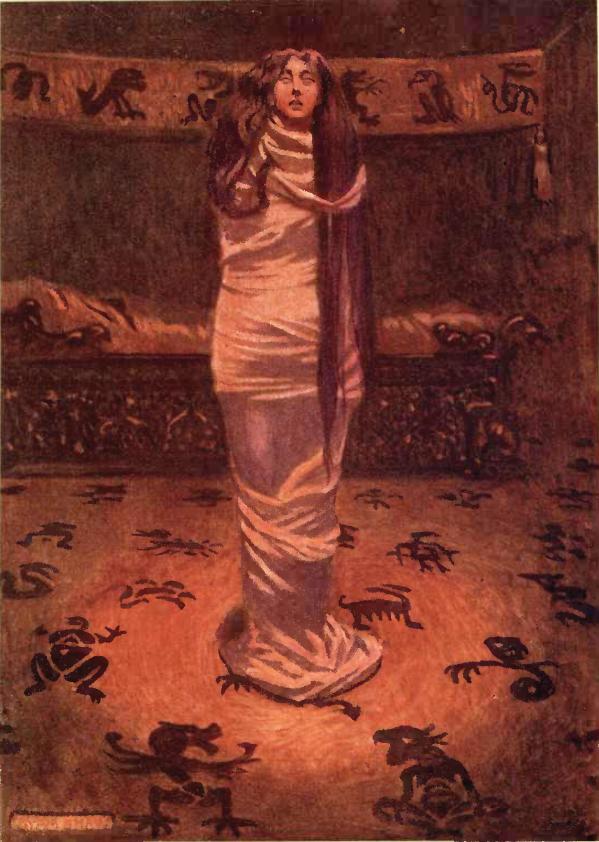
Characters and structure
The main figures are the narrator, Ligeia, and Rowena. Ligeia is presented as intellectual, commanding, and almost otherworldly; Rowena is depicted as delicate and genteel. Poe arranges the tale as a confessional monologue, marked by digressions, rhetorical flourish, and shifts between reasoned description and fevered assertion. The inclusion of a short poem within the tale enhances its layered structure and underscores thematic preoccupations with mortality and destiny.
Themes and literary techniques
Central themes include death and the possibility of return, the unreliability of perception and memory, and obsessive love that blurs admiration and possession. Poe employs hallmarks of Gothic fiction—oppressive settings, heightened emotion, and hints of the supernatural—while his prose also shows careful attention to sound, rhythm, and sensory detail. Critics debate whether the apparent resurrection is supernatural, a psychological projection, or the product of altered states; Poe leaves the matter deliberately unresolved.
Composition and influences
Poe wrote "Ligeia" during a period when he drew on a variety of literary influences, including elements of Romanticism, German tales, and classical allusion. The story's learned voice and occasional references to medicine, philosophy, and art reflect Poe's interest in erudite atmosphere. Some readers and scholars have suggested that the narrator's account may be colored by grief, narcotics, or mental disturbance, but such explanations remain interpretive rather than definitive.
Publication history and revisions
First printed in 1838, "Ligeia" was revised and reprinted by Poe during his lifetime, appearing in different periodicals and collections. Contemporary reviews focused on its imaginative force and stylistic boldness. Commentators such as Charles Eames and Thomas Dunn English praised the story's conception and artistic skill, and its reputation grew as part of Poe's established corpus of tales that probe the limits of life, death, and consciousness.
Critical reception and interpretations
Over time, "Ligeia" has attracted diverse critical approaches. Formalist readings analyze Poe's control of diction and rhythm; psychological and psychoanalytic critics examine the narrator's need to possess an idealized woman; feminist scholars consider the contrast between Ligeia's intellect and Rowena's passivity and explore gendered expectations in the tale. The story's ambiguity sustains multiple plausible readings rather than a single conclusive interpretation.
Adaptations and cultural impact
The story has inspired adaptations in film and other media. A well-known cinematic adaptation is Roger Corman's loose 1964 film The Tomb of Ligeia, directed by Corman and often discussed for the ways it expands and alters Poe's plot; see the adaptation notes at Roger Corman adaptation. The film starred Vincent Price, whose performance further popularized the tale in mid-20th-century horror cinema; production and casting details are summarized at Vincent Price and the film. Various stage and audio versions have emphasized different aspects of the story's uncanny power.
Legacy
"Ligeia" remains central to studies of Poe because it encapsulates his fusion of poetic technique and macabre subject matter. Its compactness and intensity make it a frequent subject in anthologies and courses on Gothic literature. The story exemplifies how an unreliable voice and concentrated lyricism can create a sustained mood of unease and fascination, influencing later writers of psychological horror and dark romantic fiction.
Further notes
- The tale includes the poem commonly titled "The Conqueror Worm", which frames the story's meditation on mortality.
- Scholars differ on whether the narrator's account is literal or hallucinatory; the ambiguity is a deliberate aesthetic choice.
- For readers interested in cinematic treatment, the Corman-Price film is a notable example of midcentury Poe adaptations; see adaptation overview and production notes.
Reading suggestions
Readers approaching "Ligeia" for the first time may benefit from close attention to narrative voice, repeated images, and the embedded poem. Comparing the story with Poe's other tales of obsession and loss helps situate its themes within his larger body of work and within 19th-century Gothic and Romantic movements.
Related articles
Author
AlegsaOnline.com Ligeia — short story by Edgar Allan Poe Leandro Alegsa
URL: https://en.alegsaonline.com/art/57924
Sources
- en.wikisource.org : Ligeia
- commons.wikimedia.org : Ligeia