
Arbuckle Mountains — an ancient Oklahoma range
A concise overview of the Arbuckle Mountains in south-central Oklahoma: geology, landscape, human use, recreation, and notable features near Davis and Turner Falls.
Overview
The Arbuckle Mountains are a compact, geologically old range located in south-central Oklahoma in the United States. They stand out as a region where deeply buried rocks have been exposed by uplift and erosion, producing a rugged landscape of rounded hills, cliffs, springs and waterfalls. The town of Davis lies at the northern edge of the range and serves as a common gateway for visitors.
Image gallery
6 Images


Geology and landscape
The range represents an eroded uplift rather than a long linear chain of high peaks. Exposed rocks include ancient crystalline basement and folded sedimentary layers that record a long span of Earth history from Precambrian through early Paleozoic times. Limestone and dolomite beds are common, creating karst terrain with caves, springs and solution features. The pattern of uplift and subsequent erosion produced isolated ridges and steep escarpments that contrast with surrounding plains.
History and human use
For millennia the hills provided resources and travel corridors to Indigenous peoples, and later the area became a focus for ranching, small-scale quarrying and tourism. The Arbuckles also overlay aquifers that supply water to local communities and sustain springs and streams. Scientific interest in the range centers on its exposed deep rocks, structural features and fossil-bearing strata in some of the sedimentary layers.
Recreation and notable places
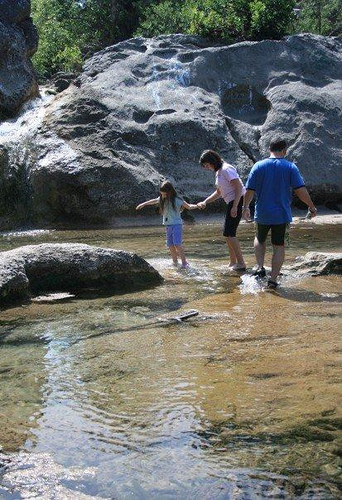
- Turner Falls and its swimming areas are among the region's best-known destinations near Davis.
- Hiking, bouldering, birdwatching and cave exploration attract visitors to public parks and private preserves.
- Scenic drives and overlooks emphasize the contrast between upland ridges and surrounding plains.
For local information and visitor services, Davis functions as a hub; see resources about the range and nearby facilities at Davis, Oklahoma and general references to the Arbuckle Mountains.
Distinctive features
The Arbuckles are notable for being a relatively small but geologically complex area with exposed older rocks, extensive karst development, and a high recreational value relative to their size. Their combination of waterfalls, rock outcrops and springs makes them a prominent natural landmark in south-central the United States.
Tags
Related articles
Author
AlegsaOnline.com Arbuckle Mountains — an ancient Oklahoma range Leandro Alegsa
URL: https://en.alegsaonline.com/art/5238