
Jhalawan — historical region of Balochistan
Jhalawan was a historical region and princely territory in what is now southern Balochistan, established in the 17th century and later bound with Sindh by an 1853 frontier settlement.
Jhalawan was a historical territorial unit in the area of present-day southern Balochistan. Formed in the 17th century, it developed as a polity within the broader Baloch tribal and dynastic landscape and is commonly described in modern accounts as one of the regions associated with the Khanate of Kalat.
Image gallery
1 Image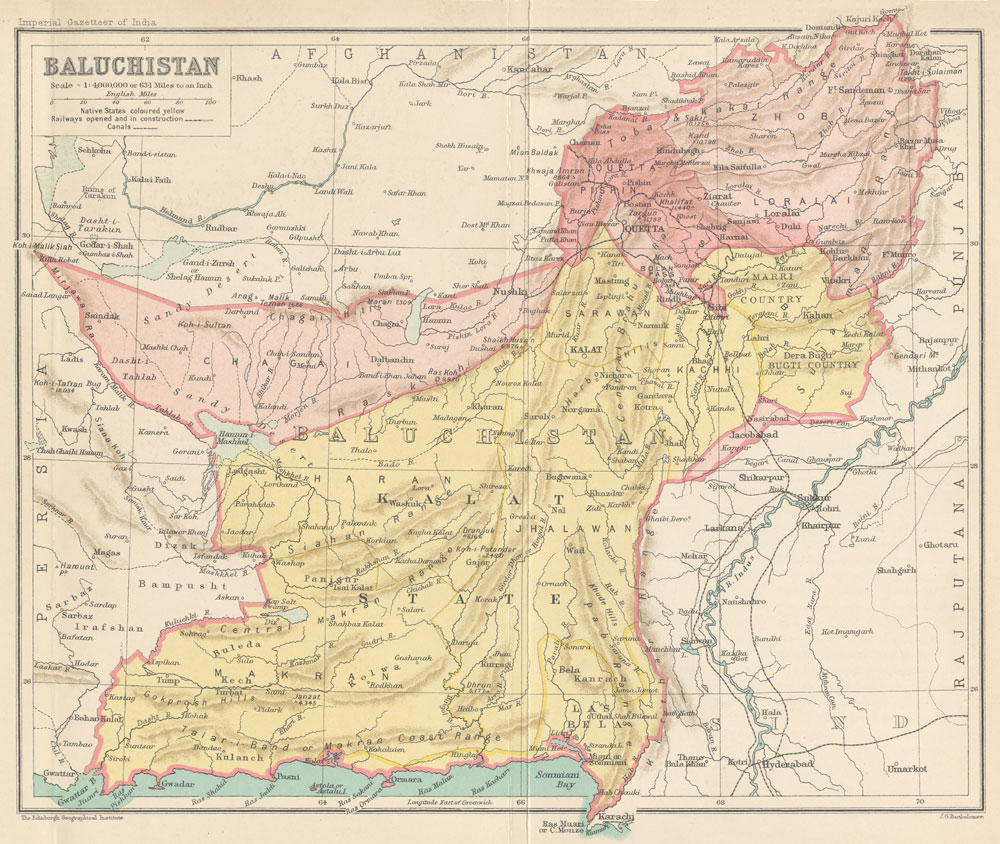
Geography and identity
The name Jhalawan designated a region rather than a nation-state in the modern sense. Its lands lay inland from the Indus plain and bordered territories that later became part of Sindh. The population was largely Baloch, organized in tribal groupings whose leaders exercised local authority under larger regional rulers. Because of its position, Jhalawan served as a frontier zone between the highlands and the more settled plains to the east.
History and administration
Established as a distinct jurisdiction in the 17th century, Jhalawan came to be administered under local chiefs who recognised the suzerainty of larger rulers in the region. Over time the area was incorporated into the political structure that historians associate with the Khanate of Kalat, a dominant power in Balochistan from the 17th century into the colonial era.
Boundary and colonial contacts
During the 19th century, as British influence expanded on the Indian subcontinent, formal boundary arrangements were made between neighbouring territories. In 1853 a frontier between Jhalawan's territory and Sindh was fixed in negotiations and mappings of the period. This delimitation reflected both local power relations and the strategic priorities of external authorities.
Legacy and significance
Today Jhalawan survives mainly as a historical name used in studies of Baloch history and administration. Its territory now lies within the modern province of Balochistan in Pakistan. Scholars and local histories cite Jhalawan when discussing the development of tribal rule, regional identities, and frontier relations with neighbouring Sindh (Sindh).
- Established: 17th century (historical formation)
- Political character: tribal territories under regional suzerainty
- Notable event: boundary with Sindh fixed in 1853
- Modern context: territory now in Pakistan's Balochistan province
Because surviving documentary evidence is uneven, accounts of Jhalawan emphasize broad developments—tribal organization, regional rule, and frontier adjustment—rather than precise administrative details. For more detailed archival or regional studies, specialist works on the Khanate of Kalat and colonial frontier policies are useful starting points.
Related articles
Author
AlegsaOnline.com Jhalawan — historical region of Balochistan Leandro Alegsa
URL: https://en.alegsaonline.com/art/50141