
Japanese Wikipedia
The Japanese-language edition of Wikipedia, launched in September 2002. A volunteer-built, free online encyclopedia in Japanese notable for its community, article scope, and historical growth.
Overview
The Japanese Wikipedia is the edition of Wikipedia written in Japanese. It is a collaboratively edited, free online encyclopedia maintained by volunteers and hosted under the Wikimedia movement. Readers and contributors use Japanese scripts (kanji, hiragana, katakana) and specialized conventions for names, dates and terminology, which shape how topics are described and organized.
Image gallery
1 Image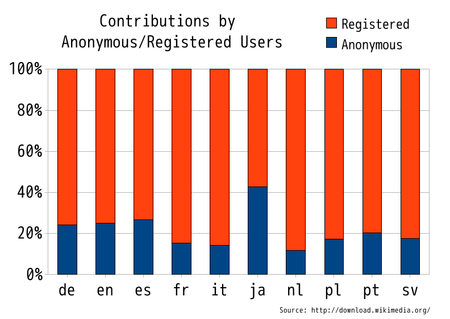
Characteristics and content
Articles range from short stubs to extensive surveys on Japan-related subjects, global topics and translations from other language editions. The project employs language-specific templates, infoboxes and style guidelines to handle issues such as kanji variants, furigana (pronunciation aids), and honorific forms. Automated editors (bots) help with routine maintenance, while human editors review translations and culturally sensitive content.
History and development
The Japanese edition began in September 2002. Its early years focused on growth and community-building; volunteers created guidance pages and technical templates to adapt the global wiki platform to Japanese usage. By 5 November 2016 it contained over 1,036,000 articles, and at one point was ranked thirteenth among language editions by article count. For more on its origins and milestones see the early history and development records.
Community, governance and quality
A volunteer community runs editorial policies, administers behavior and operates deletion and dispute-resolution processes. Core principles such as neutrality and verifiability are applied with attention to Japanese-language sources and citation practices. Featured and good article assessments signal higher-quality entries; local policies sometimes differ in emphasis from those of other language editions because of linguistic and cultural context.
Uses and significance
Japanese Wikipedia serves as a widely used reference for native speakers, learners of Japanese, researchers and journalists. It is frequently consulted for topics closely tied to Japan—history, culture, geography and public figures—but also as a gateway to international topics translated into Japanese. Educational projects and cultural institutions occasionally collaborate with editors to improve content and access.
Notable facts and distinctions
- Adapting a global encyclopedia to a language with multiple writing systems presents technical and editorial challenges.
- Local conventions for names, dates and honorifics influence article structure and style.
- The edition is part of the wider Wikimedia ecosystem and exchanges content and practices with other language projects; see the Japanese Wikipedia portal for community resources and tools.
Related articles
Author
AlegsaOnline.com Japanese Wikipedia Leandro Alegsa
URL: https://en.alegsaonline.com/art/49550
Sources
- meta.wikimedia.org : "List of Wikipedias"