
Hengist and Horsa
Semi-legendary 5th-century brothers traditionally associated with the early Anglo-Saxon settlement of Britain and the founding of the kingdom of Kent; their story mixes history and myth.
Overview
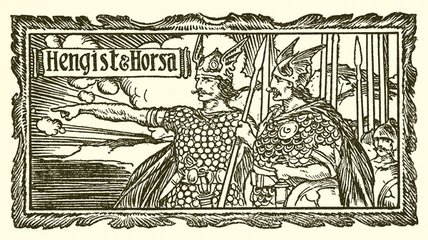
Hengist and Horsa are two brothers described in early medieval sources as leaders who arrived in Britain in the period often called the 5th century. Their names are Old English in form—Hengist meaning "stallion" and Horsa meaning "horse"—and they are linked most closely with the foundation of the kingdom of Kent in what is now southeast England. Accounts present them as warrior-chieftains whose presence marks a stage in the broader settlement of Britain by Germanic-speaking groups after the end of Roman rule.
Image gallery
10 Images





Sources and historicity
The narrative about Hengist and Horsa survives mainly in a small group of medieval texts, notably the Ecclesiastical History of the English People by Bede, the Anglo-Saxon Chronicle, and earlier compilations such as the Historia Brittonum. These works blend oral tradition and political legend; modern scholars treat many details as uncertain. While the brothers figure prominently in later national histories, their individual historicity—whether they were actual persons, eponymous founders, or partly legendary figures—remains debated.
Traditional narrative
In the traditional story, continental warriors were invited by British rulers to help resist raids and internal enemies; unhindered settlement followed, leading to military confrontations with native Britons. Horsa is said to have fallen in combat, and Hengist to have become a leading figure in Kentish affairs. Medieval narratives also attribute episodes of alliance, betrayal, and dynastic marriage to them; these elements reflect later attempts to explain the emergence of Anglo-Saxon polities rather than straightforward contemporary reportage.
Legacy and cultural impact
Hengist and Horsa have long served as symbols in English historical memory. They are invoked as ancestral founders in chronicles, later literature, and local tradition in Kent and beyond. Their names and the tale of two horse-themed brothers have attracted attention from historians, antiquarians, and writers who use the story to explore themes of migration, conquest, and cultural change in early medieval Britain.
Distinctions and interpretation
- Ethnic labels: Sources sometimes describe them as Jutes or Saxons; the exact identity of migrating groups varied and is a matter of scholarly interpretation.
- Archaeology vs. narrative: Material evidence shows patterns of migration and cultural shifts in southeastern Britain, but it cannot directly confirm individual characters from the chronicles.
- Symbolic names: The horse-related names may be literal personal names, symbolic titles, or later inventions shaped by storytelling conventions.
Primary sources and further reading
For primary accounts, consult medieval compilations and later translations cited in scholarly summaries. Modern studies place the Hengist-and-Horsa tradition in the context of post-Roman Britain, migration archaeology, and the formation of early English kingdoms. See entries and discussions in general histories and reference works for balanced overviews.
Kent | Southeast England | 5th century | Settlement of Britain
Related articles
Author
AlegsaOnline.com Hengist and Horsa Leandro Alegsa
URL: https://en.alegsaonline.com/art/43502