
He Said, She Said (1991 film)
1991 romantic comedy that retells a single relationship from alternating male and female perspectives. Co-directed by Ken Kwapis and Marisa Silver, starring Kevin Bacon and Elizabeth Perkins, distributed by Paramount.
He Said, She Said is a 1991 romantic comedy that examines a romantic relationship by presenting the same events twice, once from each partner's viewpoint. The film was co-directed by Ken Kwapis and Marisa Silver and released by Paramount Pictures. It stars Kevin Bacon and Elizabeth Perkins, with supporting performances by Nathan Lane, Sharon Stone and Anthony LaPaglia.
Image gallery
1 Image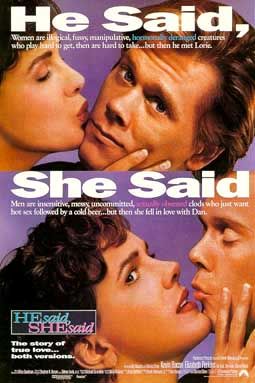
Overview
The film's principal conceit is to show how memory, emphasis and emotion shape personal narratives. Rather than offering a single continuous account, the story is divided into paired segments: moments that are seen first through the male protagonist's eyes and then revisited from the female protagonist's perspective. This structure encourages viewers to compare details, tonal shifts and the ways minor actions are interpreted differently by each person.
Structure and style
The co-directing arrangement meant each half of the film could adopt a distinct visual and tonal approach. One director emphasized certain framing, reaction shots and pacing while the other responded to the same scenes with different priorities, so editing and mise-en-scène underscore how authorship affects meaning. The device is used to explore subjective truth rather than to create a mystery.
Cast and production
- Kevin Bacon — lead role
- Elizabeth Perkins — lead role
- Nathan Lane — supporting role
- Sharon Stone — supporting role
- Anthony LaPaglia — supporting role
Casting combined established and rising performers of the period, and the dual-author approach to direction was an explicit creative choice intended to make the competing perspectives feel individually authored rather than merely edited together. As with many studio releases, marketing emphasized both the stars and the formal twist.
Release and reception
Upon release the film received mixed to positive notices. Critics commonly praised the chemistry of the leads and the clarity of the central idea, while some considered the device occasionally gimmicky or uneven in execution. Audiences and reviewers noted that the film's success depends largely on the performances and the editing that frames parallel moments.
Legacy and significance
He Said, She Said is often cited as a mainstream example of split-perspective storytelling and is discussed in studies of narrative reliability and gendered perception in romantic comedy. It remains a reference point for filmmakers and teachers examining how editing, direction and point of view shape audience sympathy and interpretation. For further information consult studio and performer records and retrospective criticism from film scholars and reviewers associated with Paramount Pictures.
Related articles
Author
AlegsaOnline.com He Said, She Said (1991 film) Leandro Alegsa
URL: https://en.alegsaonline.com/art/43017