
Hamelin (Hameln): German town famous for the Pied Piper
Hamelin (Hameln) is a town on the River Weser in Lower Saxony, Germany, known for its well-preserved medieval centre and the Pied Piper legend that shapes much of its cultural identity.
Overview
Hamelin (German: Hameln) is a historic town in Lower Saxony, Germany, situated on the River Weser. It serves as the centre of the Hamelin-Pyrmont district and has a population of roughly fifty- to sixty-thousand inhabitants in recent decades. The town combines a regional administrative role with light industry, services and a tourism sector built around its architectural heritage and literary associations. Transport links include river access and regional road and rail connections.
Image gallery
10 Images




Characteristics and notable places
The centre of Hamelin features a largely intact medieval and early modern streetscape with numerous timber-framed houses, a prominent market square and several churches. Key visitors' attractions and civic sites include:
- the old market and town hall area with historic façades,
- the Rattenfängerhaus (Pied Piper House), a landmark tied to the town's most famous story,
- museums and exhibitions presenting local history and folklore,
- nearby parks and the Weser riverfront, which are popular for walking and seasonal events.
Neighborhoods around the historic core combine residential areas, small manufacturing and services that support the wider district.
History and the Pied Piper
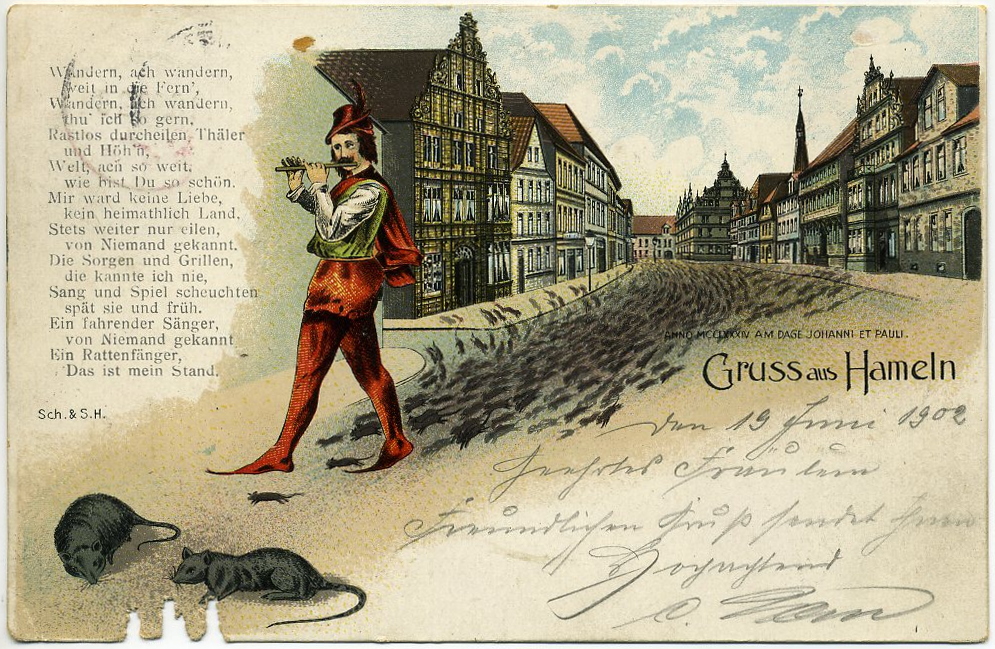
Hamelin's origins reach back to the Middle Ages when river trade and local crafts encouraged growth. The town is internationally known because of the medieval tale commonly called "The Pied Piper of Hamelin" (Der Rattenfänger von Hameln). Local chronicles and folklore associate the event with the year 1284, and the story—about a piper who led away the town's children after a dispute—has been retold in many languages and artistic forms. For background and historical discussion see contemporary accounts and summaries at accounts of the Pied Piper legend.
Hamelin commemorates the story in public art, guided walks and an interpretive programme that examines both the myth and the ways medieval towns recorded crises and migrations.
Culture, tourism and significance
The Pied Piper motif has shaped Hamelin's identity: festivals, theatrical performances and shops cater to visitors intrigued by the tale. Museums explain local daily life across centuries and present archaeological and archival material. The town also promotes cultural events, educational programmes for schools and international exchanges. Practical visitor information and municipal services are available through the Hameln official site.
Beyond the legend, Hamelin is valued as an example of a regional centre that preserves historical architecture while functioning as a modern small city within Germany's federal system.
Related articles
Author
AlegsaOnline.com Hamelin (Hameln): German town famous for the Pied Piper Leandro Alegsa
URL: https://en.alegsaonline.com/art/42020
Sources
- destatis.de : "Alle politisch selbständigen Gemeinden mit ausgewählten Merkmalen am 31.12.2018 (4. Quartal)" · web.archive.org
- www1.nls.niedersachsen.de : Landesbetrieb für Statistik und Kommunikationstechnologie Niedersachsen, 102 Bevölkerung - Basis Zensus 2011, Stand 31. Dezember 2015 (Tabelle K1020014)