
Grace Hopper — pioneering computer scientist and U.S. Navy officer
Grace Hopper (1906–1992) was an American computer scientist and U.S. Navy rear admiral who helped create early compilers, influenced COBOL, and popularized the term “debugging.”
Overview
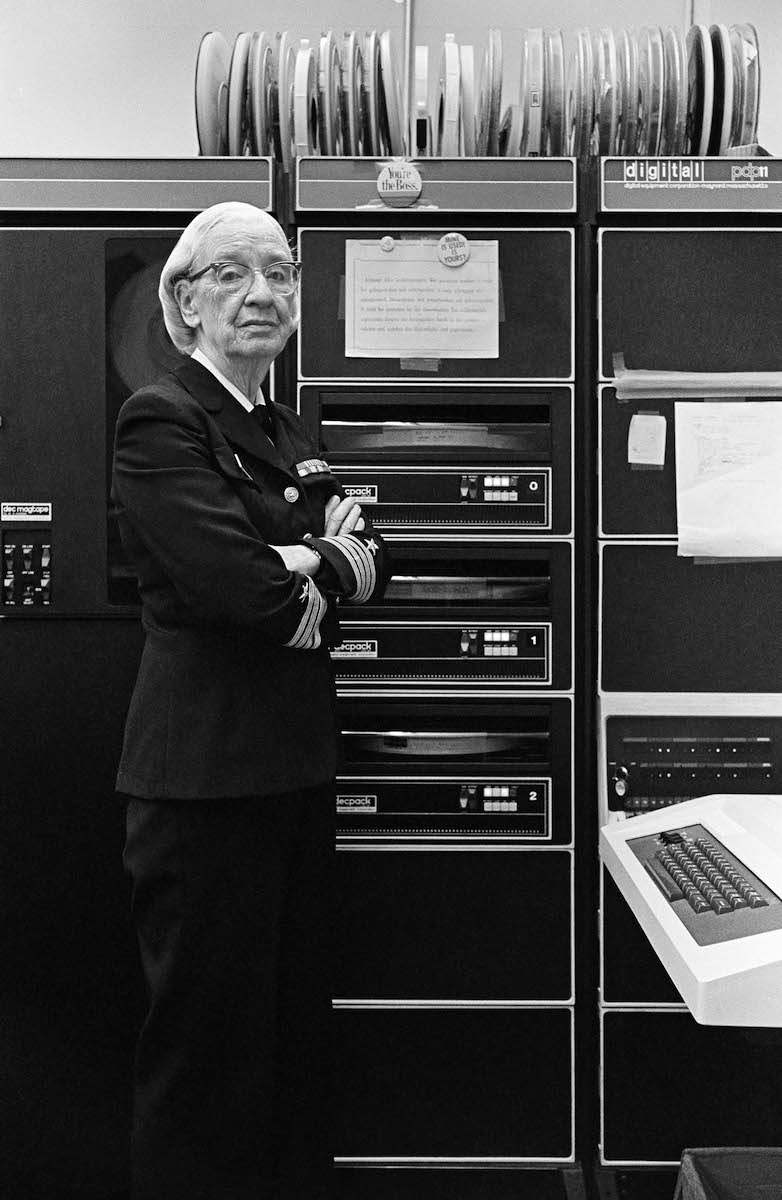
Grace Murray Hopper (born December 9, 1906 – died January 1, 1992) was an American mathematician, computer scientist and United States Navy officer. She is best known for her leadership in early programming language design, the development of compiler concepts, and for helping to bridge mathematical theory and practical computing during and after World War II. Her life combined academic work, military service and industrial innovation.
Image gallery
7 Images



Early life and education
Hopper earned a Ph.D. in mathematics from Yale and taught at college before joining the U.S. naval reserve during World War II. Her academic training gave her the theoretical background she later applied to electromechanical and electronic computing machines. For basic biographical details see birth and early life and accounts of her academic career at education.
Technical contributions and career
Hopper worked on the Harvard Mark I and later on commercial machines. She conceived and implemented tools that translated human-readable instructions into machine code, an innovation that led to the first compiler-like systems. Her work on business-oriented languages produced FLOW-MATIC, which directly influenced the development of COBOL and widened the accessibility of programming to non-specialists. Contemporary descriptions of her technical projects are available via technical summaries.
Legacy and influence
Hopper’s advocacy for machine-independent programming and her promotion of higher-level languages helped shape modern software development. She remained a visible public figure who encouraged young people, especially women, to enter computing and the military. Her legacy is evident in programming education, industry practices, and ongoing honors from professional organizations; see recognitions listed at honors and awards.
Notable facts
- She popularized the anecdote of “debugging” a computer after an insect was found lodged in hardware; the story helped cement the term in computing culture.
- Her nickname, sometimes cited in histories, was “Amazing Grace,” reflecting both her technical skill and public persona.
- Hopper reached flag rank in the U.S. Navy and continued to consult on computing matters after formal retirement; for military records see service record.
Hopper’s career stands at the intersection of mathematics, engineering and organizational change. Her practical inventions and clear commitment to education and outreach left a durable imprint on how software is written and taught.
Related articles
Author
AlegsaOnline.com Grace Hopper — pioneering computer scientist and U.S. Navy officer Leandro Alegsa
URL: https://en.alegsaonline.com/art/40041
Sources
- arlingtonva.us : "ARLINGTON COUNTY NAMES NEW PARK FOR NAVY ADMIRAL"
- mirror.co.uk : "Grace Hopper: Top 10 facts about computer scientist honoured by Google Doodle"
- wikidata.org : wikidata.org/wiki/Q11641
- dl.acm.org : 81100172438
- authority.bibsys.no : 98034489
- catalogue.bnf.fr : cb16228841g
- data.bnf.fr : (data)
- dblp.org : 51/3005
- d-nb.info : 121579948
- isni.org : 0000 0001 1034 9992
- id.loc.gov : n83175996
- genealogy.math.ndsu.nodak.edu : 15664
- aleph.nkp.cz : jx20100825003
- nla.gov.au : 36506213
- uli.nli.org.il : 004740227