
Ancestor table (ahnentafel) — numbered ancestry chart
An ancestor table (ahnentafel) is a compact numbering system for a person's direct ancestors that assigns each ancestor a fixed number for easy reference and indexing.
Overview
An ancestor table, often called an ahnentafel, is a method of presenting a person's direct-line ancestors as a numbered list rather than a branching diagram. It compresses the information of a family tree into a compact, linear form that is easy to cite, sort, and share. The German term ahnentafel is frequently used in genealogical literature, and the format is commonly linked with the names Sosa and Stradonitz.
Image gallery
4 Images

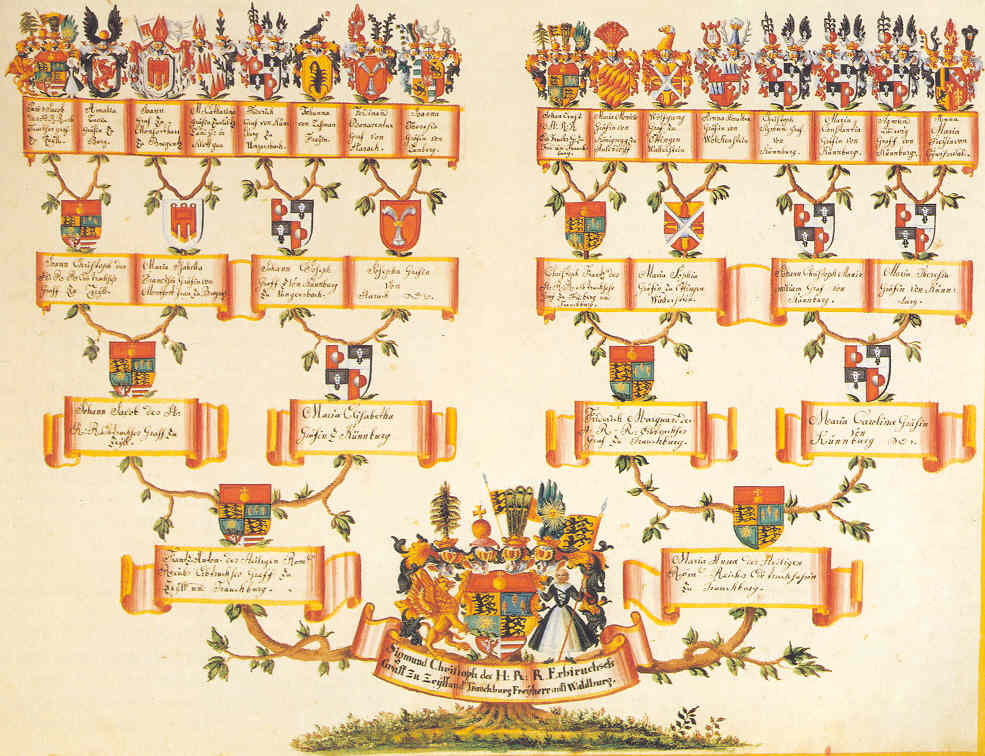

Numbering system and basic rules
The system assigns the subject (the person whose ancestry is being recorded) the number 1. In the simplest formulation, the father's number is always double that of the subject, and the mother's number is double plus one. That is, if person n is listed, then their father is 2n and their mother is 2n+1. This arithmetic rule makes relationships easy to compute: even numbers are male ancestors and odd numbers (greater than 1) are female ancestors. The sequence continues outward generation by generation.
- 1 — subject
- 2 — father (2 × 1)
- 3 — mother (2 × 1 + 1)
- 4 — father's father (2 × 2)
- 5 — father's mother (2 × 2 + 1)
- 6 — mother's father (2 × 3)
- 7 — mother's mother (2 × 3 + 1)
History and naming
The ahnentafel concept has roots in early modern European genealogical writing and was popularized in continental genealogy. The method is associated with Jerónimo de Sosa and later with Stephan Kekulé von Stradonitz, so it is often called the Sosa–Stradonitz or Sosa method in English-language sources. For background on the general idea of depicting ancestry as a list rather than a graph, see family tree references.
Uses and advantages
An ancestor table is widely used by genealogists, historians, and hobbyists because it provides a stable identifier for each ancestor that is independent of page layout or diagramming. It is useful for indexing, cross-referencing citations, and importing or exporting data in genealogical databases. Computer programs can readily calculate relationships and detect duplicates or pedigree collapse using the numerical relationships. The system also makes it straightforward to produce concise printed lists for reports.
Limitations and variations
While compact, an ahnentafel does not show collateral relatives (such as siblings, cousins, or spouses of ancestors) or the chronological or geographic context a chart might convey. Repetition of the same ancestor through different lines (pedigree collapse) leads to the same individual appearing under multiple numbers in conceptual listings, which requires careful handling in records. Various conventions exist for extended notes, generation indicators, or converting the numbers to alternative schemes; genealogists may compare the ahnentafel with pedigree charts and descendant charts in practice. For short definitions of parental roles see father and mother.
Because the numbering rule is simple and deterministic, an ahnentafel can be continued indefinitely in principle, doubling the number of entries each generation. In practice, available records, pedigree collapse, and editorial choices limit how far a printed or digital list is extended.
Further reading and tools for generating ahnentafels are commonly available in genealogical software and reference guides; some resources and software are indexed under the historical names associated with the method.
Tags
Related articles
Author
AlegsaOnline.com Ancestor table (ahnentafel) — numbered ancestry chart Leandro Alegsa
URL: https://en.alegsaonline.com/art/3816