
Geoffrey I of Anjou (Greymantle)
Geoffrey I (930–987), called Greymantle or Grisegonelle, was Count of Anjou from 960 to 987. He strengthened Angevin authority by building fortifications, securing alliances and extending influence in western France.
Overview
Geoffrey I (930–987), commonly known by the sobriquet Greymantle and in French as Grisegonelle, served as Count of Anjou from 960 until his death in 987. A member of the early Angevin dynasty that traced its roots to Ingelger, he presided over a period when regional magnates increased local autonomy amid a weak central monarchy.
Image gallery
1 Image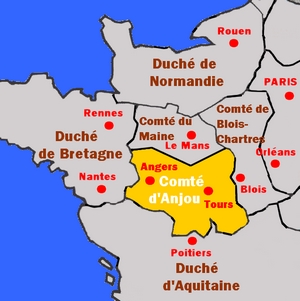
Rule and methods
Geoffrey consolidated comital authority through a mix of military action, fortification and political alliance. He reinforced or erected castles and strongholds to secure routes and counter incursions, and he used marriage and patronage to tie neighboring nobles and clerics to Angevin interests. These measures allowed Anjou to punch above its weight among the counties of northern and western France.
Political context and expansion
His career unfolded during the tenth century, a time when royal power in West Francia was fragmentary and local lords often exercised effective independence. Against this backdrop, Geoffrey sought to extend Angevin influence into adjacent territories such as Maine and Touraine, engaging in both warfare and diplomacy. Contemporary chronicles emphasize his energetic pursuit of advantage rather than long periods of stable, centralized administration.
Notable features of his tenure
- Strengthening of defensive networks around the Loire valley and key roads.
- Use of feudal ties and marriages to create durable regional alliances.
- Skilled balance between confrontation and conciliation with powerful neighbors, including Norman and Breton magnates.
- Establishment of practices and institutions that his successors would expand.
Succession and legacy
Geoffrey's death in 987 passed the county to his heir, who continued to build Angevin power. The momentum generated during his rule helped set the stage for his son, commonly known as Fulk III (often called Fulk Nerra), and for the later prominence of the house of Anjou in medieval politics. Historians view Geoffrey as a pivotal figure in transforming a regional comital lordship into a durable territorial power.
For introductions and further reading on Geoffrey and the early counts of Anjou consult general surveys of tenth-century France and specialized studies of Angevin governance; relevant entries and resources are often indexed under regional histories of Anjou and the Loire valley. See related entries on his title as Count of Anjou, on contemporaneous noble structures via French nobility, and on the development of Angevin power more broadly via Anjou.
Related articles
Author
AlegsaOnline.com Geoffrey I of Anjou (Greymantle) Leandro Alegsa
URL: https://en.alegsaonline.com/art/38112