
From Hell to Victory (1979 film)
1979 Italian–Spanish–French World War II ensemble drama directed by Umberto Lenzi, following a multinational cast in a story spanning Dunkirk to the war’s end.
From Hell to Victory is a 1979 multinational war drama produced through Italian, Spanish and French collaboration. Released internationally under several titles—Italian: Contro 4 bandiere, French: De l'enfer à la victoire, Spanish: De Dunkerke a la victoria—the film presents an ensemble account of World War II through the perspectives of characters from different countries.
Image gallery
1 Image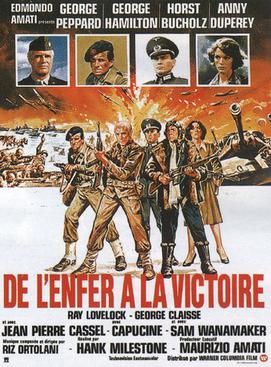
Cast and principal credits
The picture is generally credited to director Umberto Lenzi, with Edmondo Amati serving as a principal producer during the co-production process. The cast combines Hollywood and European performers in leading roles: notable names include George Peppard, George Hamilton, the German actor Horst Buchholz, and Italian actor Ray Lovelock. French performers such as Jean-Pierre Cassel and Anny Duperey also appear, together with Lambert Wilson, forming a multinational ensemble.
Overview and themes
Rather than centering on a single battle or figure, the film takes an episodic approach, following a group of friends and acquaintances whose lives are affected by major wartime events. Themes include camaraderie, the impact of war on ordinary people, national identity, and the moral choices soldiers and civilians face under extreme circumstances. The title evokes a trajectory from crisis toward eventual victory while acknowledging the human cost along the way.
Production and style
As a European co-production, the movie reflects mixed casting and multilingual elements common in films of the period. Production values combine location work with studio sequences; its visual and narrative style blends conventional war-drama tropes with character-driven episodes. The soundtrack and cinematography follow the conventions of late 1970s historical films aimed at broad international audiences.
Release, reception and legacy
On release, the film attracted attention for its international cast and broad scope, although contemporary critical and commercial responses varied by market. Over time it has been regarded as part of a wave of European co-produced war films that sought to reinterpret World War II through ensemble storytelling rather than single-hero narratives. It remains of interest to viewers studying cross-border film collaborations and representations of the war in late 20th-century cinema.
Notable facts
- The film is often cited under different alternative titles depending on language and territory.
- Production materials and credits credit Italian production participation alongside Spanish and French partners.
- Its cast mixes established American stars and prominent European actors, a common strategy for international distribution.
Related articles
Author
AlegsaOnline.com From Hell to Victory (1979 film) Leandro Alegsa
URL: https://en.alegsaonline.com/art/36805