
Flag of Liechtenstein — design, history and symbolism
The national flag of Liechtenstein features horizontal blue and red bands with a gold crown. This article explains its design, origins, symbolism, notable history and official use.
The flag of Liechtenstein is a simple but distinctive national emblem: two equal horizontal bands of blue (top) and red (bottom) with a small gold crown placed toward the hoist on the upper (blue) band. The arrangement is widely used on public buildings, government documents and at national celebrations and represents the principality at home and abroad.
Image gallery
2 Images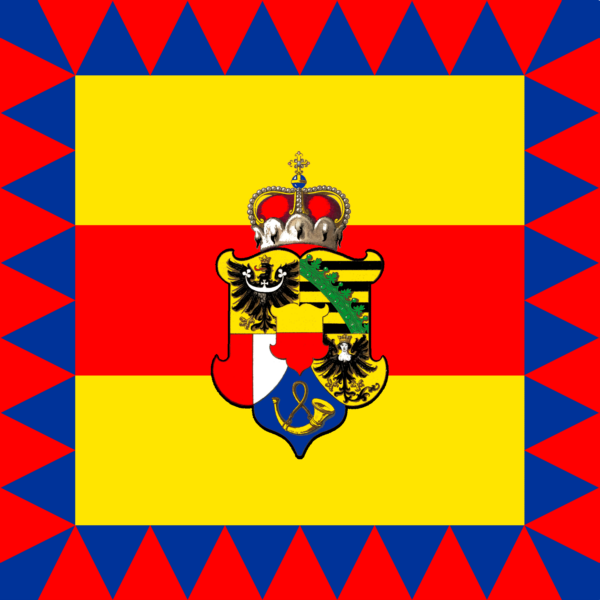

Design and symbolism
The basic elements of the flag are deliberately straightforward. The blue and red bands are equal in size, and a stylized gold crown is set on the hoist side of the blue field. Common interpretations describe blue as evoking the sky and red as recalling the evening fires of hearth and home, but the combination originally reflected colors associated with the princely household.
- Blue band: the upper horizontal stripe, traditionally connected with the sky or the prince’s colors.
- Red band: the lower stripe, often linked in popular interpretation with domestic hearth or national vitality.
- Gold crown: a symbol of the princely house and the unity of prince and people, positioned on the hoist side of the blue field.
History and development
The blue-and-red combination has roots in the colors used by Liechtenstein’s ruling family in earlier centuries. By the early 20th century the horizontal bicolour was commonly used as a national banner. A notable episode in the flag’s modern history occurred at the 1936 Olympic Games, when organisers discovered that Liechtenstein’s bicolour matched another nation’s flag. In response, a gold crown was added the following year to distinguish Liechtenstein’s banner and to emphasize the principality’s sovereignty.
The current form, featuring the crown on the blue band, has since been the standard for state and national display. Variants and ceremonial standards exist for use by the princely household and by government institutions, but the two-band layout with the crown remains the widely recognized national mark.
Beyond its visual features, the flag is a symbol of Liechtenstein’s identity as a small European principality. Official descriptions and protocol govern its display on public buildings, at diplomatic missions and during national holidays. For more detailed information about the country and official emblems see Liechtenstein and the German-language designation Flagge Liechtensteins.
Related articles
Author
AlegsaOnline.com Flag of Liechtenstein — design, history and symbolism Leandro Alegsa
URL: https://en.alegsaonline.com/art/34837
Sources
- merriam-webster.com : "Geography, Merriam-Webster's Atlas"