
Flag of Greece
The national flag of Greece: its appearance, symbolism, historical origins from the 1821–1829 independence struggle, official adoption, variations, and notable facts.
Overview
The flag of Greece is a rectangular national emblem composed of alternating blue and white horizontal stripes with a white cross on a blue canton in the upper hoist. It has been associated with the modern Greek state since the early years of the Greek War of Independence (beginning 1821) and was formally adopted in several stages during the first decades of the 19th century. The design links national, religious and maritime traditions and is commonly known in Greek by nicknames that translate as "blue-white."
Image gallery
10 Images




Design and characteristics
The conventional design features nine horizontal bands of equal height, alternating blue and white, beginning with blue at the top and ending with blue at the bottom (five blue, four white). In the upper hoist (top-left) corner sits a blue square bearing a white Greek cross. The cross symbolizes the Greek Orthodox Church, which played a central role in preserving Hellenic identity under Ottoman rule. The nine stripes have been interpreted in modern tradition as representing the nine syllables of the motto "Eleftheria i Thanatos" ("Freedom or Death"), though this explanation is folkloric rather than a formally recorded origin.
Proportions and common specifications
National practice gives the flag a rectangular proportion, commonly used as 2:3. The canton (the square with the cross) is frequently depicted with a side equal to the height of five stripes, making it visually balanced against the banded field. Exact shades of blue are not universally standardized in older descriptions, and representations vary from deep navy to lighter azure tones in different contexts such as government flags, naval ensigns and printed reproductions.
History and origins
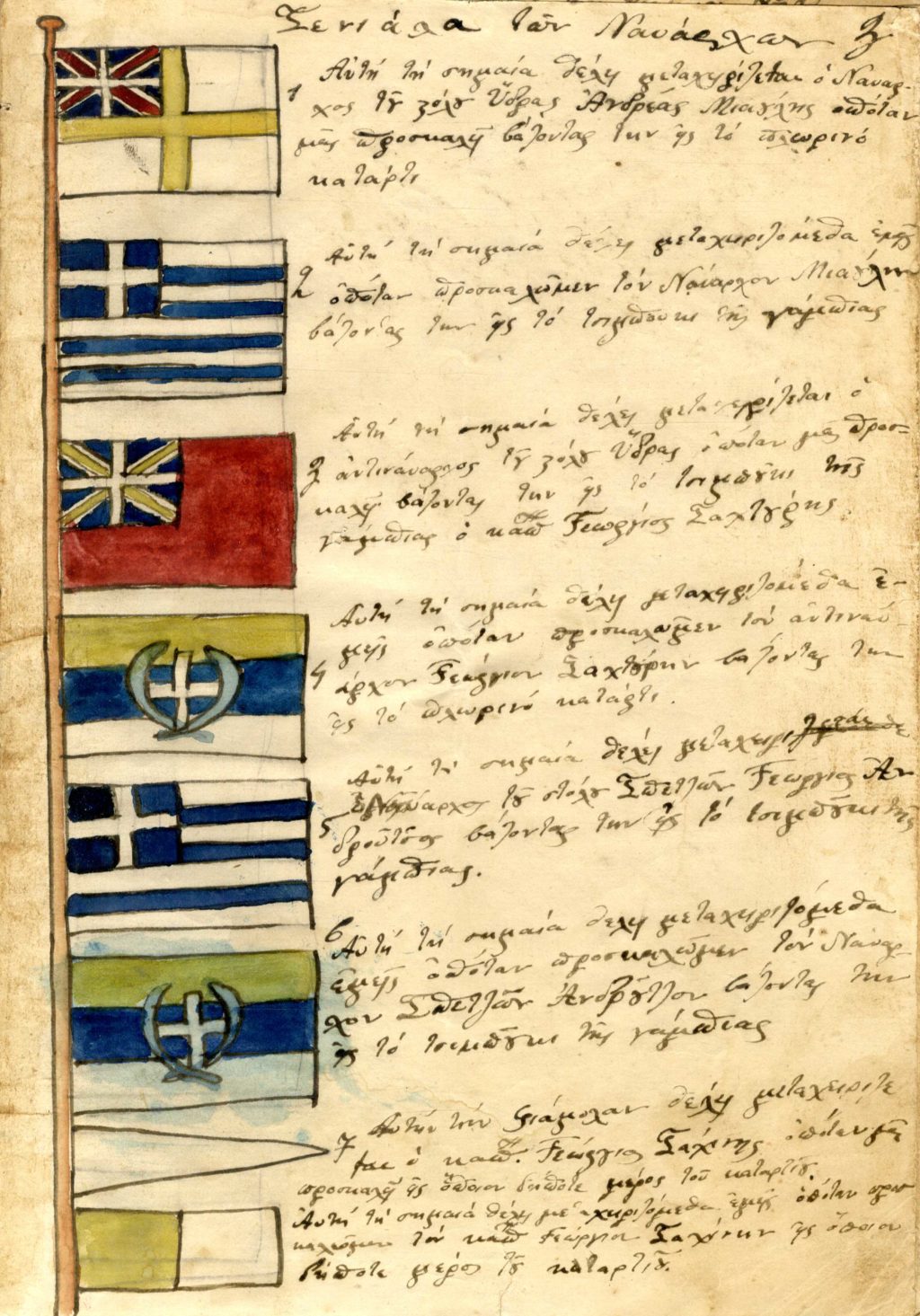
During the Greek War of Independence (1821–1829) many revolutionary groups and local leaders used banners and personal standards; a standardized national flag emerged from gatherings of revolutionary representatives. At the First National Assembly at Epidaurus in 1822 a cross-on-blue field and a striped variant were adopted for different uses—land flag, naval ensign and merchant flag—reflecting separate needs for military, state and civilian maritime identification. Over the 19th and 20th centuries these roles shifted, and in the late 20th century the striped ensign became the sole national flag used on land and at sea.
Usage, variations and protocol
- State and civil: The striped flag is used by government bodies, public institutions, private citizens and ships as a national emblem.
- Historical variants: A plain blue field with a white cross served as a land flag for a long period; a distinct merchant flag existed briefly in the early modern era.
- Etiquette: As with most national flags, it is displayed on official buildings, at ceremonies and on public holidays, and there are customary protocols for hoisting, lowering and half-masting.
Notable facts and disputes
The flag is popularly called Galanólefki or Kyanólefki in Greek, both meaning "blue-white." Some commentators have suggested visual resemblances to other historical maritime flags, and there are occasional claims comparing its striped field to merchant-company banners used elsewhere; such comparisons are debated and not part of the official history. The flag’s mix of religious symbolism and maritime elements reflects Greece’s geography and the historical role of the Orthodox Church in modern nation formation.
Further reading
Official descriptions and images are available from national archives and cultural sources. For more detailed accounts of adoption and changes over time see national records, contemporary accounts of the independence era at historical collections, nautical flag registries at maritime references, legal texts and decrees at government publications, and broader summaries and analyses at scholarly portals.
Questions and answers
Q: What does the Greek flag look like?
A: The Greek flag is rectangular and has nine equal stripes of blue and white from left to right, with a blue square in the top left corner with a white cross.
Q: When was the Greek flag first used?
A: The Greek flag was first used in 1822, when the young Greek state was fighting for its independence from the Ottoman Empire during the Greek War of Independence.
Q: When was the current flag of Greece officially adopted?
A: The current flag of Greece was officially adopted during the First national assembly of the Greeks at Epidaurus in 1822.
Q: What is a state and military ensign?
A: A state and military ensign is a flag used only by the government and the military, and only on ships.
Q: When was the ensign chosen as the sole national flag of Greece?
A: The ensign was chosen as the sole national flag of Greece in 1978.
Q: What was the third flag adopted for?
A: The third flag was adopted for the merchant fleet, to be used by civilians on ships only.
Q: What is the Greek flag sometimes known as in Greece?
A: The Greek flag is sometimes known as the blue-white, in Greek Γαλανόλευκη (Galanólefki) or Κυανόλευκη (Kyanólefki).
Related articles
Author
AlegsaOnline.com Flag of Greece Leandro Alegsa
URL: https://en.alegsaonline.com/art/34797