
Erhu — Chinese two‑stringed bowed instrument
Erhu, a two‑stringed bowed instrument of the huqin family, is central to Chinese music. Known for its expressive, vocal-like tone, it appears in solo, ensemble, opera, and modern genres.
The erhu (èrhú) is a two‑stringed bowed musical instrument from China, often called the "southern fiddle" and sometimes described in the West as a Chinese violin. It belongs to the huqin family and is prized for a lyrical, voice‑like timbre. The erhu functions both as a solo instrument and as a core member of traditional and modern Chinese ensembles, and it has been adapted into popular, cinematic and fusion contexts.
Image gallery
8 Images


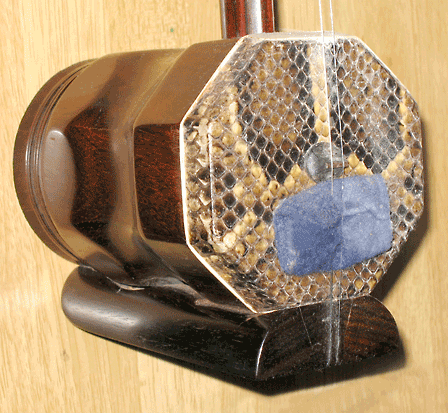
Characteristics and construction
The instrument has a long vertically held neck and a small resonator body covered on the front with snakeskin (traditionally python skin). Typical features include:
- Two metal or silk strings tuned a fifth apart (commonly to D and A).
- A small hexagonal or octagonal soundbox made of hardwood.
- A bow whose horsehair is placed between the two strings, so the player pushes or pulls the bow to contact each string.
- No fingerboard: players press the strings without a solid backing, allowing wide slides and microtonal inflections.
Technique and sound
Erhu technique emphasizes expressive slides, vibrato, and subtle changes of tone color. Because the bow hair runs between the strings, switching strings uses a distinctive wrist motion rather than lateral bowing. Players produce glissandi, harmonics, and rapid ornaments; left‑hand pressure and sliding create the instrument's characteristic vocal quality. The dynamic range and articulation allow both plaintive solos and bright ensemble passages.
History and development
As part of the broader huqin family, the erhu traces its roots to bowed instruments that entered China from Central Asian contact centuries ago. Its present form became established in the 19th and early 20th centuries and was further developed by musicians and composers who expanded its repertoire and technique. The erhu also absorbed innovations from conservatory pedagogy and orchestral practice in the 20th century, helping standardize playing positions and teaching methods.
Uses, repertoire and significance
The erhu appears in solo recitals, chamber groups, full Chinese orchestras and in accompaniment to opera. Repertoire spans traditional folk tunes and classical pieces as well as contemporary compositions, film scores, and cross‑genre collaborations in jazz and pop. Prominent early 20th‑century figures helped create pedagogical studies and transcriptions that remain part of standard training.
Related instruments and notable facts
Within the huqin family are related instruments that occupy different ranges and timbres, such as the gaohu (higher), zhonghu (lower), banhu and jinghu. Compared with the Western violin, the erhu has fewer strings and no fingerboard, producing a more nasal and intimate tone that many listeners associate closely with traditional Chinese expression. Its adaptability has made it a symbol of Chinese instrumental music both at home and abroad.
Author
AlegsaOnline.com Erhu — Chinese two‑stringed bowed instrument Leandro Alegsa
URL: https://en.alegsaonline.com/art/31872