
Enemy at the Gates
A 2001 war drama set during the Battle of Stalingrad that dramatizes a sniper duel and wartime propaganda; directed by Jean-Jacques Annaud and starring Jude Law and Ed Harris.
Enemy at the Gates is a 2001 war drama that fictionalizes events around the Battle of Stalingrad (1942–1943). The film follows the rise of a Soviet sniper and the publicity campaign built around him, combining battlefield action with personal rivalry and propaganda. It was produced as an international co-production and attracted attention for its atmosphere and visual staging.
Image gallery
2 Images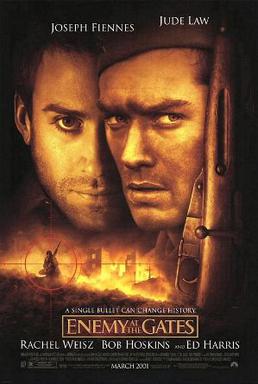

Overview and main characters
The story centers on the young Soviet marksman Vassili Zaitsev, portrayed by Jude Law, whose accuracy and luck make him a symbol of resistance. His prominence draws the attention of a German sniper commander, played by Ed Harris, and triggers a publicized duel. The cast also includes a range of supporting roles, among them a political figure portrayed by Joseph Fiennes, and the film was directed by Jean-Jacques Annaud.
Plot elements and themes
Beyond the cat-and-mouse sniper encounters, the film explores how individual acts are turned into collective myth, the strain of urban warfare, and the moral ambiguity of survival. A romantic subplot is interwoven with the combat scenes, and the narrative emphasizes both the technical craft of sniping and the psychological pressure on soldiers and civilians.
Historical basis and accuracy
Enemy at the Gates draws on real events and figures from the Battle of Stalingrad but takes liberties for dramatic effect. Vassili Zaitsev was a real Soviet sniper whose achievements became widely known; other characters and specific confrontations in the film mix documented facts with fictionalized episodes. Historians and critics have debated which elements are accurate and which are cinematic invention.
Reception and legacy
Critics praised the film's tense set pieces, production design, and lead performances, while some reviewers and historians criticized its historical simplifications and melodramatic aspects. It remains a frequently cited example of a war film that foregrounds the personal and propagandistic dimensions of combat rather than serving as a literal documentary.
Notable aspects
- Emphasis on sniper tactics and urban warfare.
- Interaction between individual heroism and wartime propaganda.
- International cast and director, blending Hollywood and European filmmaking approaches.
Related articles
Author
AlegsaOnline.com Enemy at the Gates Leandro Alegsa
URL: https://en.alegsaonline.com/art/31410