
Dunkirk (2017 film)
Christopher Nolan's 2017 war film about the Dunkirk evacuation (May–June 1940), noted for its interwoven timelines, IMAX cinematography, immersive sound design, practical effects and ensemble cast.
Overview
Christopher Nolan wrote, co-produced and directed Dunkirk, a 2017 British–American war drama that dramatizes the evacuation of Allied soldiers from the beaches around Dunkirk, France, during May–June 1940. The film favors a cinematic reconstruction of experience over conventional biographical or political exposition, presenting events through a set of intersecting perspectives rather than a single lead character. The ensemble cast includes both established actors and relative newcomers in roles that represent military personnel, civilian volunteers and aircrews.
Image gallery
8 Images



Narrative structure and style
Dunkirk is widely noted for its interwoven timeline: three narrative strands follow events on land, at sea and in the air, each with a distinct temporal span that are edited together to create mounting suspense. Dialogue is deliberately sparse; Nolan emphasizes visual composition, pacing, and sound to convey danger, disorientation and urgency. The film’s editing compresses and overlaps subjective experiences to produce an almost documentary immediacy while maintaining narrative coherence.
Production and technical approach
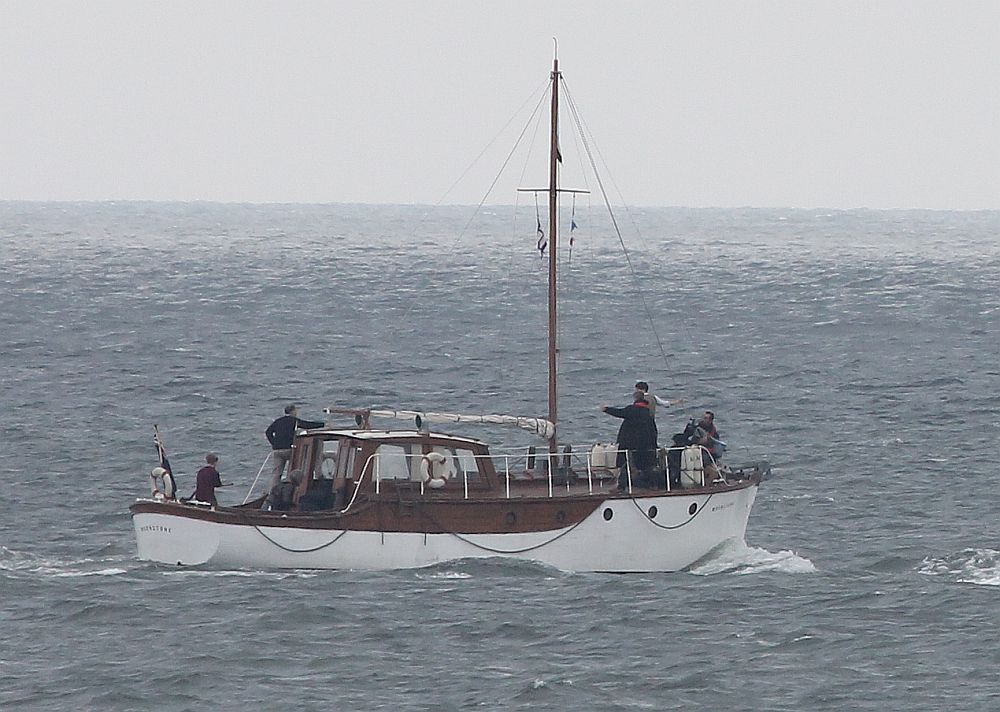
The production emphasized practical filmmaking techniques. Large-format film photography, including IMAX cameras, was used to capture expansive seascapes and the scale of the evacuation. Cinematographer Hoyte van Hoytema worked with practical lighting and wide-format lenses to create a tactile, immersive look. Filming used restored period vessels, genuine aircraft where possible and full-scale sets; visual effects were employed mainly to augment and extend in-camera elements rather than replace them. These choices contribute to a sense of realism and materially grounded spectacle.
Music and sound
The score and sound design are central to the film’s impact. Composer Hans Zimmer created a score built around persistent rhythmic motifs that reinforce the film’s tension, while the sound mix layers engines, waves and human voices to heighten immediacy. Sound editing and mixing work with the picture editing to shape tempo and emotional intensity, often placing the audience within the sensory environment of the characters.
Historical basis and depiction
Based on the real Operation Dynamo evacuation, the film concentrates on small-scale human experiences during a large military withdrawal rather than on strategic decision-making. It depicts the contribution of Royal Navy vessels and civilian "little ships," the dangers posed by air attacks, and the psychological pressure on soldiers waiting on the beaches. Nolan’s approach intentionally limits backstory for individuals, focusing instead on collective endurance, improvisation and rescue efforts.
Cast and performances
The cast is ensemble-driven and includes both newcomers and familiar faces: Fionn Whitehead leads a group of young soldiers, supported by Tom Glynn-Carney and Jack Lowden. Pop musician-turned-actor Harry Styles appears in a supporting role. Other principal performers are Kenneth Branagh, Cillian Murphy, Mark Rylance and Tom Hardy, each contributing to the mosaic of viewpoints that the film presents.
Reception and legacy
Critics and audiences largely praised Dunkirk for its technical achievements, immersive presentation and taut direction. The film garnered significant awards attention for its sound, editing and cinematography and is often cited as a contemporary example of large-scale practical filmmaking in the war-genre. Its emphasis on atmosphere, structure and sensory immediacy has made it a frequent subject of discussion in studies of modern cinematic depictions of historical events.
- Key elements: ensemble cast, interwoven timelines, practical effects, IMAX cinematography.
- Technical highlights: large-format film, location shooting, authentic vessels and aircraft.
- Artistic focus: sound-driven tension, sparse dialogue, experiential storytelling.
Questions and answers
Q: Who wrote, co-produced, and directed Dunkirk (2017 movie)?
A: Christopher Nolan wrote, co-produced, and directed Dunkirk (2017 movie).
Q: Who are some of the actors that starred in Dunkirk (2017 movie)?
A: Some of the actors that starred in Dunkirk (2017 movie) include Fionn Whitehead, Tom Glynn-Carney, Jack Lowden, Harry Styles, Aneurin Barnard, James D'Arcy, Barry Keoghan, Kenneth Branagh, Cillian Murphy, Mark Rylance, and Tom Hardy.
Q: What genre is Dunkirk (2017 movie)?
A: Dunkirk (2017 movie) is a war drama.
Q: What countries were involved in producing Dunkirk (2017 movie)?
A: Dunkirk (2017 movie) was produced by both British and American production companies.
Q: When was Dunkirk (2017 movie) released?
A: Dunkirk (2017 movie) was released in 2017.
Q: What is the plot of Dunkirk (2017 movie)?
A: Dunkirk (2017 movie) follows the story of Allied soldiers from Belgium, the British Empire, Canada, and France as they are surrounded by the German army and evacuated during a fierce battle in World War II.
Q: Who are some of the main characters in Dunkirk (2017 movie)?
A: Some of the main characters in Dunkirk (2017 movie) include Tommy (played by Fionn Whitehead), Alex (played by Harry Styles), Commander Bolton (played by Kenneth Branagh), and Pilot Farrier (played by Tom Hardy).
Related articles
Author
AlegsaOnline.com Dunkirk (2017 film) Leandro Alegsa
URL: https://en.alegsaonline.com/art/29249
Sources
- independent.co.uk : "Dunkirk trailer: Watch the tense first teaser for Christopher Nolan's new World War II film" · web.archive.org
- pressreader.com : "Dunkirk" Empire, 29 Dec 2016
- fubarradio.com : "Will Attenborough brings 'Dunkirk' to life on Film-ish" FUBAR Radio, 6 Feb 2018
- newstatesman.com : "How realistic are Dunkirk's Spitfire flight scenes?" · web.archive.org
- nytimes.com : "Ticking Watch. Boat Engine. Slowness. The Secrets of the 'Dunkirk' Score" · archive.is