
Departments of Haiti: administrative divisions, history, and role
Overview of Haiti's ten departments — their names, subdivisions, historical origin under Toussaint L'Ouverture, administrative role, and notable geographic and political features.
The Republic of Haiti is organized into ten first-level administrative units called departments (French: départements). These departments serve as the largest subnational jurisdictions for governance, planning, and delivery of public services. Each department is centered on an administrative capital (chef-lieu) and contains a mix of urban centers, rural towns, coastal areas and interior highlands.
Image gallery
2 Images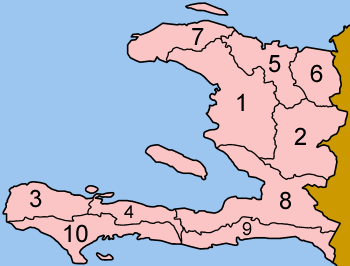

Names and basic characteristics
The ten departments of Haiti are Artibonite, Centre, Grand'Anse, Nippes, Nord, Nord-Est, Nord-Ouest, Ouest, Sud and Sud-Est. They differ greatly in size, population, economic activity and topography. For example, the Ouest department contains the national capital and largest metropolitan area, while departments such as Nord-Ouest and Grand'Anse are more sparsely populated and largely rural.
Subdivisions and administration
Each department is further divided into smaller administrative levels. Departments are grouped into arrondissements, which in turn are subdivided into communes, and communes may be broken down into communal sections. Counts reported in different sources vary over time, but there are roughly around forty arrondissements and well over one hundred communes that make up Haiti's municipal framework. These tiers provide the structure for local government, civil registration, and basic public services.
Historical development
The departmental system reflects both indigenous practice and colonial legacy. During the French colonial period of Saint-Domingue, the territory was organized into larger provinces; historical accounts note three principal divisions commonly described as North, South and West. Under the leadership of Toussaint L'Ouverture and the revolutionary administrations of the late 18th and early 19th centuries, these older provincial boundaries were transformed into departments, adapting European administrative terminology to the new independent state (French colonial era and colonial provinces).
Role and significance
Departments are important for national elections, disaster response, economic planning and statistical reporting. Provincial capitals coordinate governmental functions and often host regional courts, public hospitals and education institutions. The geographic diversity of departments means some are focused on agriculture and fisheries, others on commerce, services and industry centered around urban corridors and ports.
Notable practical facts include the presence of international ports and border crossings in several departments, the vulnerability of coastal and lowland departments to hurricanes and flooding, and the concentration of population and infrastructure in the Ouest department around Port-au-Prince. For concise maps and administrative listings consult national and international reference sources via the official pages linked from general resources.
For further reading and official references on the country's administrative organization see national profiles and gazetteers available online: Haiti country overview, the glossary for the French term département, historical background on the French colonial era, and descriptions of the earlier colonial provinces.
Related articles
Author
AlegsaOnline.com Departments of Haiti: administrative divisions, history, and role Leandro Alegsa
URL: https://en.alegsaonline.com/art/26684