
Compulsion (1959 film)
A 1959 American crime drama directed by Richard Fleischer, adapted from Meyer Levin's novel and loosely based on the Leopold and Loeb case; noted for its courtroom drama and Orson Welles's performance.
Overview
Compulsion is a 1959 American crime drama directed by Richard Fleischer and released by 20th Century Fox. The screenplay adapts Meyer Levin's 1956 novel, itself a fictionalized account inspired by the notorious 1924 Leopold and Loeb murder case. The film examines guilt, moral responsibility, and the limits of legal defense through a stylized courtroom narrative.
Image gallery
7 Images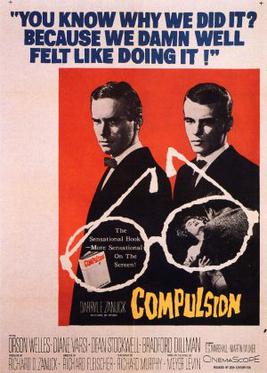





Plot elements and themes
The story follows two privileged young men who commit a calculated crime to test theories about superiority and moral exemption, and the subsequent trial that forces public debate about nature versus nurture, free will, and legal ethics. Much of the drama unfolds in the courtroom and through the relationship between the accused and their high-profile defense lawyer.
Production and source
Richard Fleischer directed a cast led by Orson Welles and featuring Dean Stockwell and Bradford Dillman among others. The film preserves the novel's focus on psychology and social context rather than sensational details, and it uses the courtroom as a stage to probe philosophical questions. The adaptation streamlines the book's material for a compact, dialogue-driven format.
Cast and performances
- Orson Welles — praised for a commanding and controlled turn as the defense attorney.
- Dean Stockwell — portrays one of the young men at the center of the crime.
- Diane Varsi — appears in a supporting role that grounds the story emotionally.
- E. G. Marshall — contributes to the film's sober depiction of justice.
- Bradford Dillman — co-stars as the other conspirator.
- Martin Milner — among a cast that includes Edward Binns and others in key roles.
Reception and legacy
On release, the film attracted attention for its moral seriousness and Welles's performance rather than for sensationalism. Critics noted its restraint and the ways it raised questions about legal advocacy, social privilege, and adolescent rebellion. Today it is often referenced in discussions of courtroom dramas and films that adapt true-crime material into fictionalized moral inquiry.
Notable distinctions
Compulsion stands out for its literary origin and its deliberate avoidance of lurid detail in favor of psychological examination. As an early example of a film that translates a real criminal case into a character-driven drama, it influenced later movies that examine the interplay between law, media, and public opinion.
Related articles
Author
AlegsaOnline.com Compulsion (1959 film) Leandro Alegsa
URL: https://en.alegsaonline.com/art/22289