
Carmen Sandiego: educational game series and multimedia franchise
Carmen Sandiego is a long-running edutainment franchise that began with a 1985 geography game and grew into a multi-format property combining detective play, curricular content and popular adaptations.
Overview
Carmen Sandiego is a fictional international thief and the central figure of an educational mystery franchise that began as a series of computer games in 1985. The original title, Where in the World Is Carmen Sandiego?, introduced players to a detective-style format that combines clue-finding, research and travel logistics with curricular topics such as geography, history and culture. Success in the games depends on interpreting clues, identifying places or facts, and making deductions rather than on fast reflexes.
Image gallery
2 Images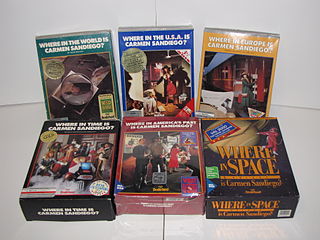

Origins and development
The series was developed in the mid-1980s as part of a movement to create software that taught while entertaining. Early entries established recurring elements: short cases or missions, themed subject matter (world geography, U.S. geography, history, languages), a cast of suspects and accomplices who leave clues, and an emphasis on reading, inquiry and use of reference materials. These design choices made the games especially useful in school settings as well as at home.
Notable titles and releases
Beyond the original 1985 game, the franchise expanded into several themed sequels and spin-offs such as Where in the U.S. Is Carmen Sandiego? and Where in Time Is Carmen Sandiego? Over decades the property was updated for new computer platforms and educational networks. The series was initially published by Broderbund and later transferred between owners; it continued to see periodic revivals and re-releases, including modern updates intended for contemporary devices.
Gameplay and educational design
Typical gameplay emphasizes critical thinking and content acquisition. Players collect and interpret clues about landmarks, languages, historical events or cultural practices, consult in-game or external reference resources, and use that information to travel between locations, issue warrants and close cases. Many titles include scoring or time-pressure mechanics to reward efficient detective work. Designers deliberately aligned game tasks with curriculum objectives, which encouraged teachers to integrate the software into lessons.
Adaptations and media
The Carmen Sandiego concept moved beyond software into television, print and streaming. A televised game show adaptation brought the franchise to broadcast audiences and further popularized its educational aims. In later years, animated reimaginings and reboots reframed the character and backstory for new, often younger viewers, while preserving the series’ globe-trotting, clue-based core.
Legacy and impact
Carmen Sandiego is widely cited as a landmark of edutainment: it demonstrated that learning-oriented software can be engaging, replayable and culturally impactful. The character’s visual iconography and the franchise’s approach to teaching through mystery have influenced generations of educational designers. Over the life of the franchise it received numerous awards and recognition for combining curriculum content with gameplay, and it remains a reference point in discussions of how interactive media can support learning.
Classroom use and pedagogy
Educators have used Carmen Sandiego titles as supplements to classroom instruction, assigning cases as group activities, research projects or homework. The games encourage skills such as source consultation, critical reading, map use and logical inference. Because players learn by solving authentic-seeming problems rather than by rote memorization, the series is often discussed in pedagogy as an example of contextualized, problem-based learning.
Contemporary revivals
Interest in the franchise has led to periodic revivals, remakes and new adaptations aimed at both nostalgic adults and new children’s audiences. These versions update presentation, interfaces and content to reflect modern technology while retaining the core mechanics that emphasize learning through investigation.
Related articles
Author
AlegsaOnline.com Carmen Sandiego: educational game series and multimedia franchise Leandro Alegsa
URL: https://en.alegsaonline.com/art/17129