
Candyman (fictional character)
Candyman is a horror figure created from a Clive Barker short story and popularized by films; a vengeful, hook-handed specter tied to racial violence, urban legend and mirror-summoning folklore.
The Candyman is a fictional horror figure most widely known from cinema and contemporary urban folklore. Originating in a short story by Clive Barker titled "The Forbidden", the character was adapted and expanded for the screen into a series of films. In popular accounts he appears as Daniel Robitaille, a formerly successful African-American artist who was lynched and gruesomely murdered after a relationship with a white woman in the late 19th century. As a supernatural antagonist he haunts mirrors and enacts violent retribution on those who invoke his name.
Image gallery
1 Image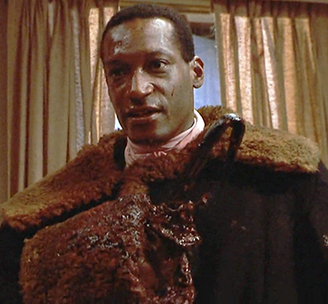
Appearance, abilities and ritual
Candyman is typically shown as a tall, gaunt figure with a hook in place of one hand and trailing wounds along his torso. His signature method of being summoned is the act of speaking his name repeatedly while facing a mirror; in most cinematic tellings saying "Candyman" five times will call him. His powers are supernatural rather than purely physical: he is portrayed as an undead presence who can appear and disappear, induce fear, and kill in brutal ways. Bees, hook wounds, and mirror imagery are recurring motifs linked to his mythology.
Origins and adaptations
The character's literary seed comes from Barker's short work, which explored themes of forbidden love and revenge. Filmmakers adapted and reinterpreted that premise for the screen, situating the legend within urban settings and giving it explicit racial and historical backstory. The 1992 film Candyman (directed by Bernard Rose) established many of the elements widely associated with the figure and made actor Tony Todd closely identified with the role. Subsequent sequels and reworkings expanded or changed details about his origin and methods.
Cultural themes and interpretations
Beyond horror thrills, the Candyman myth has been analyzed as commentary on social issues. Film versions foreground historical racial violence, the consequences of lynching, and how myths spread through communities. Critics and scholars have read the story as addressing trauma, memory, gentrification, and the power of rumor. The character functions both as a supernatural villain and as a symbol of unresolved racial injustice.
Appearances and variations
- Literary source: Barker's short story "The Forbidden", which inspired the film adaptations.
- Original film cycle: the early films built a specific backstory and visual language around Daniel Robitaille and his hook.
- Urban-legend mechanics: the mirror ritual and name-repetition are central to most portrayals and to discussions of the figure as a modern folk legend (urban legend).
- Revivals and reimaginings: later works have altered motive or setting; a recent revival explores the myth's resonance in a contemporary cityscape (2021 sequel).
Interpretations also note interpersonal taboos: the original narrative hinge is a prohibited or interracial relationship that triggers the violence which turns a man into a legend. The Candyman figure thus blends classical slasher iconography with folklore and social critique, and performances—most notably by Tony Todd—have cemented his place in horror cinema. For readers and viewers, the character operates on multiple levels: as a supernatural antagonist, as a vehicle for exploring historical wrongs, and as a cautionary tale about belief, denial, and the stories communities tell themselves.
Related articles
Author
AlegsaOnline.com Candyman (fictional character) Leandro Alegsa
URL: https://en.alegsaonline.com/art/16538
Sources
- rollingstone.com : "'Candyman': Why This Racially Charged Horror Movie Is Scarier Than Ever"
- bloody-disgusting.com : "Who's The Best Slasher Killer?"
- whatculture.com : "10 Slasher Villains With The Highest Body Counts"