
Butterflies Are Free (1972) — film overview and legacy
1972 American comedy-drama adapted from Leonard Gershe's play. Directed by Milton Katselas, starring Goldie Hawn and Edward Albert; received three Academy Award nominations and one win.
Butterflies Are Free is a 1972 American comedy-drama adapted from the stage play by Leonard Gershe and directed by Milton Katselas. The film follows a young blind man, Don, who moves into his own apartment as an assertion of independence after years of sheltered living, and the relationship that develops with his free-spirited neighbor, Jill. The drama examines the push and pull between autonomy and protection as Don negotiates new social freedoms while confronting his mother's deep anxiety about his safety.
Image gallery
1 Image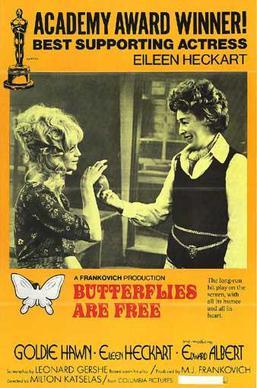
Cast and production
The picture stars Goldie Hawn as the neighbor and Edward Albert as the blind protagonist, supported by a strong turn from Eileen Heckart as the protective mother. Directed by Milton Katselas, the film was released by Columbia Pictures. The screenplay retains much of the play's emphasis on character interaction and dialogue, with adjustments made to open the setting for the screen and to make the story more visually varied.
Plot and themes
The core narrative concerns Don's assertion of self-determination: moving out, starting to date, and learning to function independently in everyday life. Jill's nonconformist attitude and humor contrast with the mother's cautious, controlling instincts. Major themes include individual freedom, the limits and responsibilities of caregiving, misconceptions about disability, and the generational shifts in attitudes toward relationships and personal choice that were prominent in the early 1970s. The film blends light romantic comedy with more serious moments, using warmth and situational humor to probe emotional truth rather than relying on dramatic spectacle.
Adaptation from the stage
Because the story originated as a stage play by Leonard Gershe, the film preserves the play's focus on intimate, character-driven scenes. The cinematic version expands certain settings and inserts brief exterior sequences to take advantage of the medium, but much of the film's energy comes from close exchanges and the chemistry between the principal performers. Directors working from theatrical material often face the challenge of balancing fidelity to the source with the need to exploit film's visual possibilities; this film is often cited as an example of a relatively faithful, performance-led adaptation.
Reception and awards
Upon release the film received attention for its performances and humane approach to its subject. It was nominated for three Academy Awards and won one in 1973. Critics at the time and in later appraisals praised the supporting work and noted the effective blend of comedy and pathos. Reviewers also discussed how the film contributed to public conversations about representation of disability in mainstream cinema, commending its sympathetic portrayal while also noting the film's roots in a theatrical format.
Legacy
- The film is remembered as a character-focused drama that mixes humor and seriousness in ways typical of several American films of the early 1970s.
- It served as an important credit in the careers of its stars and remains a reference point in discussions of stage-to-screen adaptations and portrayals of disabled characters in popular culture.
- Contemporary viewers and scholars often revisit the film to consider how attitudes toward independence, disability and family dynamics have shifted since its release.
For readers seeking more detail about the cast, production history or contemporary reviews, biographies of the principal actors and studio production notes provide further context. Archival interviews and retrospective essays also expand on the film's making and the choices involved in adapting a popular play for a wider cinema audience.
Questions and answers
Q: When was Butterflies Are Free released?
A: Butterflies Are Free was released in 1972.
Q: Who directed Butterflies Are Free?
A: Butterflies Are Free was directed by Milton Katselas.
Q: What is the basis of the movie Butterflies Are Free?
A: The movie Butterflies Are Free is based on the play of the same name by Leonard Gershe.
Q: Who are the main actors in Butterflies Are Free?
A: The main actors in Butterflies Are Free are Goldie Hawn, Edward Albert, Eileen Heckart, and Michael Glaser.
Q: Which film studio distributed the movie Butterflies Are Free?
A: The movie Butterflies Are Free was distributed by Columbia Pictures.
Q: How many Oscar nominations did Butterflies Are Free receive?
A: Butterflies Are Free was nominated for 3 Oscars.
Q: Did Butterflies Are Free win an Academy Award?
A: Yes, Butterflies Are Free won an Academy Award in 1973.
Related articles
Author
AlegsaOnline.com Butterflies Are Free (1972) — film overview and legacy Leandro Alegsa
URL: https://en.alegsaonline.com/art/15685