
Bubble Bobble (1986 video game)
Arcade platform game by Taito (1986) starring dragons Bub and Bob; players trap enemies in bubbles, navigate 100 levels, and rescue the protagonists' girlfriends. Known for co-op play and hidden endings.
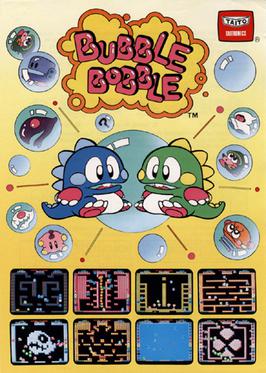
Bubble Bobble is a single‑and‑two‑player arcade platform game released by Taito in 1986. Players control two small dragons, Bub and Bob, who use bubbles as their primary weapon and mobility tool. The core objective is to progress through a series of screens—commonly described as a hundred stages—to defeat enemies, collect items and ultimately rescue the protagonists' girlfriends. The game became notable for its approachable mechanics, cooperative play, catchy soundtrack, and multiple endings.
Image gallery
3 Images
Gameplay and mechanics
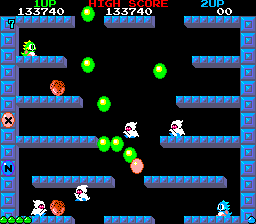
Gameplay centers on movement across single‑screen stages populated by various monsters. The dragons blow bubbles that can trap enemies; trapped foes can be popped to defeat them and produce points and bonus items. Bubbles can also be used as temporary platforms or to wall off hazards, adding a simple puzzle element to each stage. Combined enemy captures and chaining of pops raise the score, and many levels hide bonuses or secret routes.
- Attack method: bubble creation to trap and defeat enemies.
- Progression: a long sequence of distinct single‑screen stages (often cited as 100).
- Multiplayer: simultaneous two‑player co‑op with interactions that affect endings and scoring.
- Rewards: items, points and temporary power‑ups that alter bubble behavior.
Design, history and versions
Developed by Taito during the mid‑1980s arcade boom, Bubble Bobble combined platforming with arcade scoring to appeal to a wide audience. After its original arcade run, it was ported to numerous home systems of the era—most notably cartridge consoles and a variety of 8‑ and 16‑bit home computers—bringing its simple yet deep play loop to a larger audience. The game’s level design, memorable tunes, and cooperative focus helped it spawn a series of sequels and spinoffs that explored different mechanics while keeping the recognizable characters.
Legacy and notable features
Bubble Bobble is often remembered for several distinctive elements: its emphasis on cooperative play, secret rooms and bonus stages, and the existence of alternate endings that encourage two‑player teamwork to reveal the “true” ending. It influenced later platform and puzzle hybrids by demonstrating how a single, tightly designed mechanic (the bubble) could create varied challenges. The title remains a frequently reissued classic in retro collections and is celebrated among arcade aficionados.
Further reading
For more on the company and original arcade context, see Taito’s arcade releases and histories: Taito and general information about arcade platforms: arcade.
Tags
Related articles
Author
AlegsaOnline.com Bubble Bobble (1986 video game) Leandro Alegsa
URL: https://en.alegsaonline.com/art/14974
Sources
- arcade-museum.com : "Bubble Bobble - Videogame by Taito"
- nesguide.com : "Bubble Bobble (NES) - Taito, 1988 | NESguide"