
Windows NT 4.0 — Microsoft 32-bit enterprise operating system (1996)
Windows NT 4.0 is a 32-bit, preemptively multitasked operating system from Microsoft, released in 1996 for workstations and servers and widely used in enterprise environments in the late 1990s.
Overview
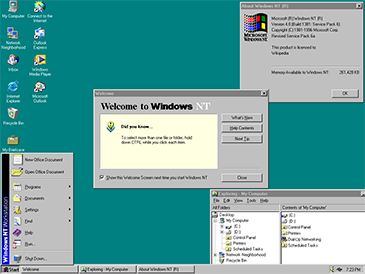
Windows NT 4.0 is a 32-bit operating system developed by Microsoft as part of the Windows NT family. It was released to manufacturing on July 31, 1996 and became generally available on August 24, 1996. NT 4.0 was offered in both workstation and server editions and combined the stability-oriented architecture of the NT line with a graphical shell very similar to the then-new Windows 95 user interface. It was designed for professional and enterprise use, emphasizing security, stability and support for multiprocessor hardware.
Image gallery
2 Images
Architecture and key characteristics
NT 4.0 uses a hybrid kernel design with a clear separation between kernel-mode and user-mode components. The operating system supports preemptive multitasking and symmetric multiprocessing (SMP), enabling it to run on uniprocessor systems as well as multi-CPU servers. It implements the Win32 API for 32-bit applications and provided limited compatibility layers for legacy subsystems. The shell and many user-facing components were updated to match the look and feel of consumer Windows at the time.
- Kernel: 32-bit hybrid kernel with device driver model and Hardware Abstraction Layer (HAL).
- Execution: Preemptive multitasking and SMP support for improved throughput on servers.
- Compatibility: Native Win32 support; constrained legacy (16-bit) compatibility compared with consumer releases.
- Interface: Explorer-based GUI similar to Windows 95 (visual style).
Editions, deployment and common uses
Microsoft released NT 4.0 in multiple variants to address different needs. The workstation edition targeted desktop professionals and developers, while server editions provided services such as file and print sharing, domain controller capabilities, and application hosting. A specialized Terminal Server option later allowed remote desktop-style sessions for multiple users on the same machine. Enterprises used NT 4.0 as a platform for business applications, network services and early internet/intranet servers.
- Workstation: desktop use, developer and professional environments (workstation edition).
- Server: file/print, domain and application serving for business networks.
- Terminal Server and other specialized builds for multi-user or high-availability scenarios.
History and legacy
NT 4.0 represented a maturation of the NT architecture and closed the visual gap between Microsoft's consumer and enterprise operating systems by adopting an Explorer-based shell. It succeeded earlier NT releases and was later succeeded by Windows 2000, which introduced Active Directory and further enterprise features. During its supported lifetime NT 4.0 received a series of updates and service packs to address security and compatibility. The platform left a lasting impact on enterprise computing by demonstrating the viability of a stable, commercially supported 32-bit server operating system from Microsoft.
Notable distinctions and compatibility notes
Compared with consumer Windows of the same era, NT 4.0 placed greater emphasis on robustness, process isolation and administrative control. It supported a range of hardware architectures beyond x86 in some builds and provided network and domain services that were foundational for corporate IT in the 1990s. Administrators migrating from or to NT 4.0 had to consider driver compatibility and application support, since newer consumer-focused features and later server technologies were introduced after NT 4.0's lifecycle. For historical context and resources about the NT family, see related material from Microsoft and archival documentation (Microsoft, product information).
Author
AlegsaOnline.com Windows NT 4.0 — Microsoft 32-bit enterprise operating system (1996) Leandro Alegsa
URL: https://en.alegsaonline.com/art/147943